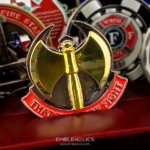
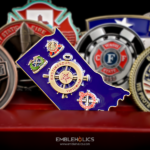
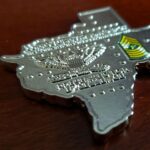
The request was short: a distinctive coin in the shape of the state of Texas, with the insignia on the front and nothing else on that face. The reverse carries the text and graphics.
Coins at a Depot or Maintenance Facility
Depots are among the most overlooked coin clients in the Army, and the reasons they fit are specific.
The workforce is largely civilian and long-serving. Unlike a unit where people rotate every few years, a depot has artisans, machinists and technicians who spend careers at the same facility. That produces a stronger attachment to the place than most military organizations manage.
The work is invisible when it goes well. Aviation repair and remanufacturing is measured by aircraft returned to service, which produces no ceremony and nothing to photograph. A coin is one of the few available forms of recognition.
The facility outlasts everyone in it. Which argues for a coin built around the depot itself rather than a current program, a commander or a year.
And a depot hosts visitors constantly. Program offices, contractors, inspection teams and customers from the units whose aircraft are being worked on. That is a steady flow of people to hand a coin to.
See also a Defense Logistics Agency coin and more Army challenge coins.
Texas as a Coin Outline
Texas is the single best state to cut a coin to, and it is worth explaining why rather than treating it as obvious.
The silhouette is unmistakable worldwide. Very few state outlines are recognized outside their own region. Texas is one, which means the shape identifies the coin to anybody who picks it up rather than only to locals.
The body is large and solid. Most of the shape is a broad mass, so artwork sits comfortably across it. Compare a lobed or irregular state, where everything has to fit the largest contiguous area, which is often far smaller than the outline suggests.
The panhandle is the only fragility point. A single narrow projection at the top, which needs slight thickening. One weak spot is manageable where Florida, Oklahoma and Idaho each have sections demanding more intervention.
And it has orientation built in. The shape has an obvious top and bottom, so the design has an axis without one having to be imposed.
The states that do not work are the rectangles. Colorado and Wyoming cut to shape read as rectangular coins rather than states, so the outline does no work at all; for those an etched state outline on a round coin is the better answer. See custom shaped challenge coins.
One Device and Nothing Else
The client asked for the insignia on the front and nothing more, which on a shaped coin is the right discipline.
The reason is that a custom outline is already a strong statement. A coin cut to Texas is doing visual work before anything on its surface is read, and adding supporting elements to the same face means two things competing: the shape and the content.
Leaving one face to the device alone lets the outline and the insignia each have their moment. The reverse then takes the text and graphics, which is the right place for them, because text wants a plain field and a shaped coin’s second face is exactly that.
The general rule worth taking from this: the more unusual the outline, the less should go on the faces. A round coin can carry a crowded design because the shape asks nothing of the viewer. A shaped coin has already spent some of their attention.
Text on the Reverse of a Shaped Coin
One practical point for any state-shaped coin, since the reverse here carries the text.
An irregular outline has no consistent baseline. On a round coin, text follows the rim at a constant distance. On a state shape the distance from the center to the edge varies continuously, so rim-following text drifts closer to and further from the edge as it travels and looks like a mistake.
The solution is to set text on straight horizontal lines inside the shape rather than following the perimeter. Texas suits that particularly well, because the broad central mass gives several usable full-width lines.
About the Depot
Corpus Christi Army Depot is a Department of Defense organization and a tenant of Naval Air Station Corpus Christi, established in 1961. Its mission is to ensure aviation readiness and to sustain the nation’s Organic Industrial Base through continuous aviation repair and remanufacturing.
The city takes its name from the Roman Catholic Feast Day of Corpus Christi, the day Alonso Alvarez de Pineda found the bay in 1519. Colonel Henry Lawrence Kinney founded a frontier trading post there in 1838 and 1839, and the settlement remained small until July 1845.
An Army depot sitting on a Navy air station is worth noting as a design consideration. An organization that is a tenant of another service has two affiliations, and a coin is one of the few places that can be acknowledged without it becoming a paperwork question.
Order a State Shaped or Depot Coin
Professional artwork is free with unlimited revisions, and nothing goes into production until you approve a digital proof. The challenge coin minimum is 50 pieces, standard production runs about 45 to 50 days after final artwork approval, rush production is available on many projects, and shipping within the continental United States is included. Embleholics is veteran-owned, SDVOSB and registered in SAM.gov.
Two suggestions. On a shaped coin, keep one face to a single device, because the outline is already doing visual work and crowding the face competes with it. And expect text on a state-shaped coin to sit on straight horizontal lines rather than following the rim, since an irregular perimeter has no consistent baseline to follow. Request a free quote to begin.
Finished Coin (Front)

Finished Coin (Back)
Frequently Asked Questions
What is an army depot challenge coin?
It is a coin for a maintenance or repair depot rather than an operational unit. Depots have largely civilian, long-serving workforces and produce no ceremonies, which makes a coin one of the few forms of recognition available.
Why do depots make good coin clients?
Because the workforce stays for careers rather than rotating every few years, the work is invisible when it goes well, and the facility hosts a constant flow of program offices, contractors and customers to hand coins to.
Is Texas a good shape for a coin?
The best of the states. The silhouette is recognized worldwide rather than only regionally, the body is large and solid so artwork sits comfortably, and there is only one fragility point in the panhandle.
Which states do not work as coin shapes?
The rectangles. Colorado and Wyoming cut to shape read as rectangular coins rather than states, so the outline does no work. For those, a state outline etched onto a round coin is the better answer.
How much should go on a shaped coin’s face?
Less than on a round one. A custom outline is already doing visual work before anything on the surface is read, so one device per face lets the shape and the content each have their moment.
Why does text look wrong on a state shaped coin?
Because an irregular outline has no consistent baseline. The distance from center to edge varies continuously, so rim-following text drifts closer to and further from the edge as it travels.
Where should text go instead?
On straight horizontal lines inside the shape rather than following the perimeter. A state with a broad central mass, as Texas has, gives several usable full-width lines to work with.
Can a tenant organization show both affiliations?
Yes, and a coin is a good place for it. An Army depot on a Navy air station has two affiliations, and acknowledging both on a coin avoids making it a formal question.
More Army Projects