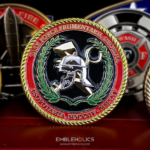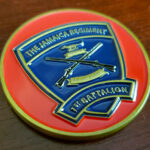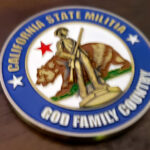
Nothing overwhelming in the design: the parent organization’s logo on one side and the regiment’s insignia on the other, etched into a shiny metal base with the elements painted. It was ordered by the 2nd Infantry Regiment of the California State Militia for its Hotel Company.
One Insignia per Face
Almost every unit sits inside a larger organization, which means almost every unit coin has to represent two things at once. Giving each one a face is the cleanest solution there is.
It removes the hierarchy problem. Put two insignias on one face and you have ranked them, because one is larger, higher or to the left. People notice, and in an organization where the relationship between a unit and its parent body matters, that is a conversation nobody wants to have over a proof.
Each device gets the space it was drawn for. Insignias are designed to stand alone at a readable size. Two on one face means each gets half of what it needs, and both lose detail. Two faces means both are shown properly.
And it gives the coin a natural order. The broader organization identifies the coin; turning it over tells you which part of it. That is a sensible way for a physical object to deliver information, and it is a better use of a reverse than filling it with text.
The approach works at any level: a company inside a regiment, a squadron inside a wing, a station inside a department, a chapter inside a national body. The only time to avoid it is when one face needs to carry something else, such as a mission statement or a presentation line.
Etched Detail on a Shiny Base
The coin uses a polished metal base with the design etched in and the elements painted, which is a straightforward combination and worth understanding.
A polished base makes painted areas look brighter. Light reflecting off the surrounding metal lifts the colors next to it, so enamel on a shiny base reads more vividly than the same color on a matte or brushed one.
It is less forgiving in the hand. A polished surface shows fingerprints and handling marks immediately. That is fine for a coin that will be displayed or kept in a case, and worth thinking about for one that will be carried daily. A brushed finish is the alternative if durability of appearance matters more than brightness.
And etched detail needs depth to survive the shine. On a polished surface, reflected light can wash out shallow line work at certain angles. Cutting the detail a little deeper than you would on a matte surface is the standard correction, which is why precision in the machining matters more here than on a textured coin.
See finish and plating options.
Keeping a Unit Coin Simple
The brief here was explicitly restrained, and that is worth defending because the pressure on a unit coin always runs the other way.
What usually happens is that everybody with an interest adds something. The parent organization’s logo, the unit insignia, the motto, the founding date, the current commander, a list of deployments. Each addition is reasonable on its own and the result is a crowded face where nothing is legible.
The discipline that works is to decide what the coin is for before deciding what goes on it. A coin issued to members needs the identity and nothing else. A coin presented for achievement needs room for a presentation line. A coin marking an anniversary needs the date. Trying to serve all three produces a coin that serves none.
A restrained design is also easy to add to and hard to subtract from, so starting sparse and adding at proof stage is the safer order of operations.
About the Organization
The 2nd Infantry Regiment of the California State Militia was formed in 2012 by three members of the 1st Regiment who wanted standardized training and a change in focus. Each unit within it is independent but shares the goal of protecting its community and the state, and a Regiment Historian maintains each unit’s lineage.
The organization supports California’s first responders, with the stated goal of being a force multiplier rather than a hindrance. A number of members serve in Community Emergency Response Teams and have completed FEMA coursework.
A volunteer organization with a regimental structure is a natural coin buyer: it has the unit identity that makes a coin meaningful, and it is self-funded at a scale that suits a 50 piece order. See also a tactical challenge coin and more military challenge coins.
Order a Coin for Your Regiment or Company
Professional artwork is free with unlimited revisions, and nothing goes into production until you approve a digital proof. The challenge coin minimum is 50 pieces, standard production runs about 45 to 50 days after final artwork approval, rush production is available on many projects, and shipping within the continental United States is included. Embleholics is veteran-owned, SDVOSB and registered in SAM.gov.
Two things that help. Decide before artwork begins whether the coin is for issue, for presentation or for an anniversary, because that decision settles what goes on it and prevents the usual accumulation. And if your organization’s emblem is held centrally, clear the use with your own leadership before ordering; we produce from artwork the customer is authorized to supply. Request a free quote to begin.
Frequently Asked Questions
What is a regiment challenge coin?
It is a coin made for a regiment or for a company within one, usually carrying the parent organization’s identity on one face and the specific unit’s insignia on the other. That split lets both devices be shown at a readable size.
Can a coin carry two different insignias?
Yes, and the cleanest way is one per face. Putting both on a single face implicitly ranks them by size and position, and each device ends up with half the space it was designed for.
Which insignia goes on the front?
Usually the broader organization, with the specific unit on the reverse. That gives the coin a natural reading order: the front identifies what it belongs to, and turning it over tells you which part.
Is a polished or brushed finish better?
It depends on use. A polished base makes painted areas look brighter because reflected light lifts the colors beside them. A brushed finish hides fingerprints and handling marks, which matters more for a coin that will be carried daily.
Does etched detail show up on a shiny coin?
Yes, if it is cut deep enough. Reflected light can wash out shallow line work on a polished surface at certain angles, so the detail is normally cut a little deeper than it would be on a matte or brushed base.
How do you stop a unit coin getting cluttered?
Decide what the coin is for before deciding what goes on it. A coin for issue needs the identity only; one for presentation needs room for a presentation line; one for an anniversary needs the date. Trying to serve all three serves none.
Should we start with a simple design or a full one?
Simple. A restrained design is easy to add to at proof stage and hard to subtract from once everybody has seen their element on it. Starting sparse is the safer order of operations.
Can a volunteer organization order challenge coins?
Yes, and they are a common customer. A volunteer unit has the shared identity that makes a coin meaningful and is usually self-funded at a scale that suits a 50 piece minimum comfortably.
More Militias Projects