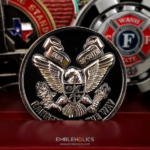
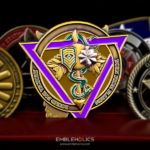
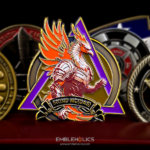
Army aviation coins almost always show the aircraft, and almost always belong to the people who fly them. This one belongs to the people who keep them flying. It was made for the 502nd Multi-Functional Company (Division Aviation Support), the aviation logistics unit supporting 2nd Infantry Division and the ROK-US Combined Division at Camp Humphreys, South Korea, and it is built around the unit’s griffin rather than around a helicopter.
The support side of army aviation
An aviation brigade is mostly people who do not fly. Maintenance, refueling, ammunition handling, supply distribution and transportation are what put aircraft in the air and keep them there, and a division aviation support company covers all of it. The 502nd describes itself as the pit crew for the division’s helicopters, which is exactly the right framing.
That has a direct consequence for the design. A coin showing an Apache or a Black Hawk in flight is a coin about the aircrew. For a support company, the aircraft is the thing they work on rather than the thing they are, and a design built around it quietly puts the unit in a supporting role on its own coin.
The alternatives that work:
- The unit mascot. The strongest option, and what this coin uses. A griffin belongs to the 502nd and to nobody else, and it needs no explanation of what the unit does.
- The tools and the trade. Wrenches, fuel, ordnance and the ground equipment of an airfield are the support unit’s own iconography and are rarely used, which makes them distinctive.
- The aircraft on the ground. If the airframe matters to the unit, showing it being worked on rather than in flight changes who the coin is about.
A griffin, and why mascots beat insignia for support units
Support and logistics units often have less visually interesting official heraldry than combat arms do, and a mascot solves that. A griffin is a strong shape, it sculpts well in relief, it carries an obvious meaning of vigilance and guarding, and it gives the coin a face.
Rendering it digitally first and then translating it into dimensional metalwork is the right order, and worth understanding as a process. A mascot drawn for a patch or a shirt is flat line art. Turning it into a struck coin means deciding which parts of it stand proud, which recede, and how deep each plane sits, and that is a separate piece of design work from the drawing itself. The digital model is where those decisions get made and checked before any steel is cut.
Combining a circle with a triangle
The coin’s outline is a circular base with a triangular upper section, which is a useful halfway house between a round coin and a fully custom shape. The circle keeps the usable flat area and the familiar coin feel; the triangle breaks the silhouette and creates a natural place for the mascot to sit above the rest of the design.
Partial shape changes are underused and inexpensive. A tab, a crest, a banner or a point added to a round coin costs far less than a fully irregular outline, because most of the profile is still a circle and only one region needs new die work. For a unit that wants its coin to stand out on a desk without paying for a figurative shape, this is usually the best value available.
Put the mascot in the added section, not the centre. The whole benefit of a partial shape is that it gives one element its own space outside the main field. Using that space for the thing you most want seen, as this coin does with the griffin, is what makes the shape worth having.
Brushed brass with enamel accents
A brushed finish on a brass-colored base is a practical specification for a unit that works with its hands. Brushed metal does not show fingerprints or fine scratches the way a polished surface does, which matters for a coin going to people in a maintenance environment. It also gives engraved detail something to read against.
Accent enamel rather than full color keeps the cost sensible and the coin legible. Color used on two or three elements draws the eye to them. Color used everywhere removes the hierarchy and costs more per coin, since enamel is charged by area on every unit rather than once in the die.
Ordering a coin for an aviation unit
Tell us whether the coin is for aircrew, for the support side, or for the whole brigade. That single answer changes the imagery more than anything else, and it is the question support units are least often asked. If your unit has a mascot, send it, even as a rough drawing, since a mascot usually makes a better coin than a generic airframe. You can see more Army challenge coins we have produced, including the aviation ordnance coin, or send your artwork through the free quote form.
Coin Front
Coin Back
Frequently Asked Questions
What is an army aviation challenge coin?
It is a coin for a unit in army aviation, which covers both the aircrew who fly and the much larger number of soldiers in maintenance, refueling, ammunition handling, supply and transportation who keep the aircraft operational. The right imagery depends heavily on which of those groups the coin is for.
Should an aviation support unit put a helicopter on its coin?
Think carefully about it. A coin showing an aircraft in flight is a coin about the aircrew, and for a support company that puts the unit in a supporting role on its own piece. The unit’s mascot, the tools and ground equipment of the trade, or an aircraft shown being worked on rather than flying all put the focus where it belongs.
Why use a mascot instead of official unit insignia?
Because support and logistics units often have less visually distinctive official heraldry than combat arms, and a mascot gives the coin a face. A mascot also belongs to that unit alone, needs no explanation, and usually sculpts well in relief, which makes it stronger on a coin than a crest that has to be read to be understood.
How does a flat mascot drawing become a coin?
Through a digital model built before any die is cut. A mascot drawn for a patch or a shirt is flat line art, and turning it into struck metal means deciding which parts stand proud, which recede, and how deep each plane sits. That modelling is separate design work from the original drawing, and doing it digitally lets those decisions be checked before tooling.
Can a coin be part round and part custom shape?
Yes, and it is one of the best value options available. Adding a tab, crest, banner or point to a circular base costs much less than a fully irregular outline, because most of the profile remains a circle and only one region needs new die work. It also gives one element its own space outside the main field, which is where the mascot should go.
What finish suits a maintenance unit’s coin?
A brushed one. Brushed metal does not record fingerprints and fine scratches the way a polished surface does, which matters for a coin carried by people working with their hands, and it gives engraved detail a surface to read against. Accent enamel on two or three elements, rather than full color, keeps both the hierarchy and the cost under control.
What does MC (DAS) stand for?
Multi-Functional Company (Division Aviation Support). It is the unit that provides aviation logistics to a division’s combat aviation brigade, covering maintenance, refueling, ammunition handling, supply distribution and transportation so that the division’s aircraft stay equipped and available.
More Army Projects