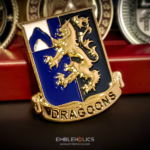
A unit coat of arms is approved heraldry rather than a logo. Every charge, colour and division of the shield is there for a documented reason, which makes putting one on a coin a job of reproduction rather than redesign. You cannot simplify a coat of arms without changing what it says.
What Is a Unit Coat of Arms?
An Army unit’s coat of arms is formally designed heraldry. It is drawn to a written specification, approved through the Army’s heraldic authority, and recorded in a blazon, which is the technical description that defines it in words rather than pictures.
That matters because of what it implies about the elements. On a corporate logo, a colour is a brand decision and a shape is a style choice. On a coat of arms, the colours are usually the branch colours, the divisions of the shield record lineage, and the charges commemorate specific campaigns, honours or predecessor units. A wavy line might record a river crossing. A particular tincture might reference the country a unit fought in.
The practical consequence for a coin: nothing on a coat of arms is decorative, so nothing on it is negotiable. A designer cannot tidy it, rebalance it or drop an element for the sake of the composition, because each of those changes alters the record.
This is also what separates a coat of arms from the other insignia a unit holds. A distinctive unit insignia, a patch, a mascot and a logo all serve different purposes and carry different levels of formality. The coat of arms is the most constrained of them.
Why Heraldry Is Harder to Put on a Coin
Because a logo can be simplified and a coat of arms cannot.
Simplification is the normal answer to coin scale. A corporate mark gets its fine lines thickened, its gradients dropped and its smallest elements removed, and it remains itself. Do the same to a coat of arms and you have removed a battle honour.
That leaves the design problem intact and removes the usual solution, so the work goes into reproduction instead. Three constraints come up every time.
Heraldry was drawn for flags and paper. Coats of arms are designed to work on a colour, a guidon, a letterhead, a plaque. All of those are larger than a coin and none of them are metal. Detail that reads perfectly at flag scale is at the edge of possibility at two inches across.
Thin lines close up and small charges merge. Fine dividing lines, slender ordinaries and small repeated charges are the first things to suffer. The strike wants to round them off and any colour fill wants to bridge them.
Adjacent colours need a wall between them. On paper two tinctures simply meet. In metal, enamel fills need a raised metal line between them to hold the colours apart, so a design where two colours meet directly has to have a boundary introduced that the blazon does not describe. That is usually acceptable, because it is a manufacturing necessity rather than an alteration to the heraldry, but it is a decision worth making knowingly rather than discovering on the proof.
Raise the coat of arms with us early and we will tell you which elements will hold at the size you want and which will need the coin to be larger.
Shaping the Coin to the Crest
Rather than a round coin, this piece is cut to follow the outline of the unit’s heraldic design.
That is a more significant decision than it looks. A round coin with a crest printed in the middle is a disc carrying a picture, and the eye reads the disc first. A coin cut to the shape of the crest has no disc. The heraldry is the object, edge to edge, and there is no border, no surrounding field and no ring of text competing with it.
For a unit whose identity is genuinely carried by its arms, that is the strongest available treatment. It also solves the scale problem from the previous section, because removing the surrounding field gives the design the entire face instead of the middle sixty percent of it, which can be the difference between a charge reading and a charge closing up.
The trade-offs are the usual ones for a shaped coin. Points and projections take the wear first, and the outline has to be resolved into something that can actually be cut, since heraldic shapes have curves and notches that a die can follow only to a point. See our page on coins cut to a unit crest for the same approach on a different design.
Creating Detailed 3D Military Artwork
Reproducing a heraldic beast with enough depth and definition to stay recognizable is the demanding part of a coin like this. Curved, organic lines are sculpted with dimensional relief so the body and surrounding details stand apart from the base metal, rather than sitting flat as an outline.
Smaller elements, including crossed rifles and lettering, have to stay clear despite their size. This is where manufacturing choices matter most: raised and recessed metal, 3D sculpting, custom shapes and plating all affect whether detailed insignia survives translation into a physical object. See our manufacturing options for the range.
There is one requirement specific to heraldry that general sculpting advice misses. A heraldic beast has a defined posture. Rampant, passant, sejant, statant. These are not descriptions of how an artist chose to draw the animal, they are part of the blazon, and the posture is as much a part of the record as the animal itself.
So the sculpting cannot flatten the pose to fit the space or exaggerate it for drama. A beast that reads as rampant on paper has to read as rampant in metal, at whatever relief depth the coin allows. That is a stricter standard than making a mascot look good, and it is the main reason heraldic sculpting takes longer. For sculpted unit devices in a less constrained context, see our page on sculpted unit devices.
About This Dragoons Coin
The 48th Infantry Regiment was originally formed in 1917. During the Second World War it was reorganized as the 48th Armored Infantry Battalion and assigned to the 7th Armored Division, seeing action in the Rhineland and at St. Vith. The regiment earned the nickname Dragoons, a term historically associated with mounted infantry and well suited to a unit known for mobility and versatility on the battlefield.
The 1st Battalion, 48th Infantry Regiment was reactivated in 2017 at Fort Leonard Wood, Missouri, where it conducts Basic Combat Training.
The coin was built around the regiment’s heraldic identity and the Dragoons name rather than around a round format. The piece is shaped to follow the heraldic outline, a sculpted dragon dominates the front in dimensional relief, crossed rifles and lettering are held at small scale, and the reverse carries regimental information.
The same regiment also has a bottle opener for the same regiment in the gallery, produced from related artwork, which is worth seeing alongside this coin if you are weighing the two formats.
Can We Use Our Unit’s Coat of Arms on a Coin?
Most units can, but the authorization has to come from the unit, not from us. Coats of arms, distinctive unit insignia, regimental crests and service marks are controlled by the organizations that own them, and heraldic designs carry their own approval process.
Worth knowing on this specifically: most units already hold an approved rendering of their coat of arms, and starting from that file is always better than having one redrawn from a photograph. A redrawn crest is a new interpretation of the blazon, and interpretations vary. The approved rendering is the one the unit is entitled to use and the one that will be recognized as correct.
Clear the artwork through your own chain of command before you order, and send us artwork your organization is authorized to supply. We produce from what the customer provides and we do not grant permission on anyone’s behalf.
Design a Coin Around Your Unit’s Crest
If your unit has a coat of arms, insignia, patch or other symbol you want represented, our artists can work from finished artwork, photographs, reference images, sketches or a basic concept, though an approved rendering is always the best starting point.
Professional artwork is free with unlimited revisions, and nothing goes into production until you approve a digital proof. The minimum order is 50 coins, standard production runs about 45 to 50 days after final artwork approval, rush production is available on many projects, and shipping within the continental United States is included. Embleholics is veteran-owned, SDVOSB and registered in SAM.gov. See more custom Army challenge coins or request a free quote.
Frequently Asked Questions
What is a unit coat of arms?
A unit coat of arms is formally approved heraldry recorded in a written blazon, where the colours, divisions and charges each commemorate something specific about the unit’s lineage, campaigns or honours. It is a documented record rather than a designed logo.
What is the difference between a coat of arms and a unit patch?
A coat of arms is approved heraldry defined by a written blazon, with every element carrying a documented meaning. A patch or shoulder insignia is worn identification and is generally simpler and less constrained. A unit may hold both, and they are not interchangeable on a coin.
Can a coat of arms be reproduced exactly on a coin?
Very closely, though metal imposes some requirements paper does not, such as raised lines between adjacent enamel colours to hold them apart. Fine detail depends on coin size, so raise the design early and we will advise which elements will hold and where a larger coin would help.
Can a coin be cut to the shape of a unit crest?
Yes. Cutting the coin to the heraldic outline removes the surrounding disc so the crest becomes the whole object, which also gives the design more usable area than a round coin of the same width. Points and projections take the most wear.
What artwork do you need for a unit coat of arms?
An approved rendering of the coat of arms is the best starting point, because a crest redrawn from a photograph is a fresh interpretation of the blazon and interpretations vary. Finished artwork, photographs, reference images or a sketch can all be worked from if no approved file is available.
What happens to fine heraldic detail at coin size?
Thin dividing lines can close up, small repeated charges can merge, and adjacent colours need a raised metal line between them to stay separate. Increasing the coin size or cutting it to the crest outline are the two most effective ways to protect fine detail.
Can we use our unit’s coat of arms on a coin?
Coats of arms and unit insignia are controlled by the organizations that own them, so permission comes from your unit rather than from a manufacturer. Clear the artwork through your chain of command and supply artwork your organization is authorized to provide, ideally the approved rendering.
What is the minimum order for unit coins?
The minimum order for custom challenge coins is 50 coins. That suits a company, battery or troop rather than a whole regiment, and larger quantities reduce the cost per coin.
More Army Projects