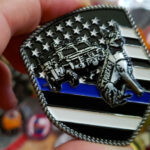
A challenge coin edge can be left plain, or cut with a decorative treatment that frames the design. Common options include rope, diamond cut, cross cut, wave, scallop and oblique or angled edges.
Edge treatments:
- Plain. Clean and unobtrusive. The default, and the right call when the faces are already busy.
- Rope. A twisted cable pattern running the circumference. Traditional, and particularly common on naval and maritime coins.
- Diamond cut. Angled facets that catch light around the rim.
- Cross cut. Perpendicular notches giving a milled, machined look.
- Wave and scallop. A shaped outer profile rather than a surface texture.
- Oblique or angled. A bevelled edge that changes how the coin sits in the hand.
The edge is one of the least used tools in coin design and one of the most effective. It adds perceived quality without competing with the artwork, which makes it especially useful on a restrained or monochrome design that would otherwise look plain.
Edge treatment is usually easier to add at the design stage than to retrofit later, so raise it before the proof is approved.
Recent Posts