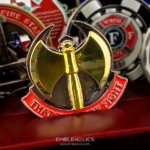
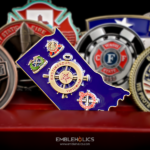
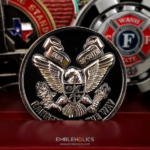
A field artillery coin has a richer set of symbols to draw on than most branches, and the restraint to use only a few of them is what separates a good one from a crowded one. This coin was made for the 56th Artillery Command, the theater fires headquarters for U.S. Army Europe and Africa, which was reactivated on 8 November 2021. It is deliberately plain: an unpainted brass-colored base with the unit insignia in relief on both faces, bold sans-serif lettering, and color drawn only from the crests themselves.
The artillery’s own vocabulary
Four symbols carry the branch, and they are recognized instantly by anyone who has served in it.
- Crossed field guns. The branch insignia, and the most direct way to say artillery on a coin. It works small, it works in plain relief, and it needs no caption.
- Scarlet. The Field Artillery’s branch color. Where a coin uses any color at all, scarlet is the one that belongs, and it does the identifying work on its own.
- Saint Barbara. The patron saint of artillerymen, and the basis of the Honorable Order of Saint Barbara conferred through the United States Field Artillery Association. For coins marking recognition rather than a unit, she is the natural subject.
- King of Battle. The branch’s own title for itself, and a motto that fits a rim without crowding it.
The nickname worth knowing is Redleg, which comes from the scarlet stripe artillerymen wore on their trousers. It appears on a great many unit coins and it lands well with the community, though it reads as insider language to anyone outside it, which makes it better suited to a coin staying within the branch than to one given to visitors.
Use one or two of these, not all four. A coin carrying crossed cannons, a scarlet field, Saint Barbara and a King of Battle motto has no hierarchy and nothing for the eye to settle on. The coin on this page uses the unit crests and nothing else, which is why it reads cleanly at arm’s length.
Battery, battalion, or command: the level sets the subject
Artillery units coin at every echelon, and the right imagery changes with each one.
A battery coin is the most personal of the three. The audience is small and known, the gun section or the battery’s own nickname and mascot often matter more than formal heraldry, and quantities are modest. This is where the most inventive artillery coins come from.
A battalion coin sits in the middle, usually combining the battalion’s distinctive unit insignia with the branch symbols. It needs to work for several batteries at once, so it stays closer to official heraldry than a battery coin does.
A command coin, like this one, represents a headquarters rather than a firing unit. That changes the imagery substantially: a theater fires headquarters does not serve guns, it synchronizes and integrates fires across a theater. Putting a howitzer on it would misrepresent what the organization does. The crests are the right subject, and the restraint is appropriate to the echelon.
Why a plain coin suits a headquarters
An unpainted coin with relief crests is a formal register, and headquarters elements tend to want it. With no enamel field, the design depends on relief depth and on the lettering, which means the choices are proportion and hierarchy rather than color. Done well it reads as a medal rather than a souvenir.
Bold sans-serif lettering is part of that effect. A serif or slab face around the rim pulls a coin toward the traditional and the historical. A clean sans-serif reads as current and institutional, which is what a recently reactivated headquarters is. It is a small decision with a disproportionate effect on how the coin is read.
Letting the crest supply the only color is the detail worth copying. Official insignia already carry prescribed colors, so reproducing them faithfully gives a plain coin a single point of color that is both accurate and purposeful. Adding any other color competes with it.
The 56th Artillery Command and its lineage
The 56th has one of the more striking lineages in the branch. It traced back to the 56th Coast Artillery Brigade, formed in 1942. Through the Cold War it operated Pershing nuclear missiles in West Germany, becoming a field artillery command in January 1986, and it was inactivated in 1991 following the INF Treaty and German reunification.
It returned thirty years later. The command was reactivated on 8 November 2021 as a two-star theater fires command, headquartered at Mainz-Kastel, Germany, to synchronize, integrate and control fires and effects for U.S. land forces across Europe and Africa. At a change of command in July 2025 it was redesignated Multi-Domain Command Europe, so a coin struck under the 56th’s name now records a specific chapter in that lineage rather than the organization’s current title. That is true of a great many unit coins, and it is a large part of why they are kept.
Ordering an artillery coin
Tell us the echelon first. Battery, battalion and command coins are different products, and knowing which one you are ordering settles most of the imagery before we start. Bring the unit’s distinctive insignia, say whether you want color at all, and tell us if the coin is for recognition rather than for the unit, because that is when Saint Barbara becomes the right subject. You can see more Army challenge coins we have produced, including the 2nd Battalion Rangers coin, or send your artwork through the free quote form.
Finished Coin (Front)

Finished Coin (Back)

Frequently Asked Questions
What symbols belong on a field artillery challenge coin?
Crossed field guns are the branch insignia and the most direct way to identify artillery. Scarlet is the Field Artillery’s branch color and does the identifying work on its own where any color is used. Saint Barbara, patron saint of artillerymen, suits recognition coins, and King of Battle is the branch motto. Use one or two of these rather than all of them, or the coin has no focal point.
Who is Saint Barbara and why is she on artillery coins?
Saint Barbara is the patron saint of artillerymen, and the basis of the Honorable Order of Saint Barbara, conferred through the United States Field Artillery Association. She appears most often on coins marking individual recognition rather than on unit coins, where the unit’s own heraldry is the better subject.
Why are artillerymen called Redlegs?
From the scarlet stripe artillerymen wore on their trousers, scarlet being the Field Artillery’s branch color. The nickname appears on many unit coins and lands well within the branch, though it reads as insider language to people outside it, so it suits a coin staying within the unit better than one given to visitors.
Should a battery coin and a battalion coin look different?
Yes. A battery coin has a small, known audience and often works better with the battery’s own nickname, mascot, or gun section identity than with formal heraldry. A battalion coin has to work across several batteries, so it stays closer to official insignia. A command coin represents a headquarters rather than a firing unit and usually drops weapons imagery altogether.
Should a headquarters coin show a howitzer?
Usually not. A theater fires headquarters synchronizes and integrates fires across a theater rather than serving guns, so a howitzer misrepresents what the organization does. Unit crests, branch insignia and a motto are the appropriate subject at that echelon, and the restraint reads as more senior rather than less interesting.
Can an artillery coin work with no enamel?
Yes, and it suits headquarters elements particularly well. Without an enamel field the design rests on relief depth, proportion and lettering, which produces a formal result closer to a medal than a souvenir. A useful technique is to let the official insignia supply the only color on the coin, since those colors are prescribed and therefore purposeful.
What was the 56th Artillery Command?
The 56th Artillery Command traced its lineage to the 56th Coast Artillery Brigade of 1942, operated Pershing nuclear missiles in West Germany through the Cold War, and was inactivated in 1991 after the INF Treaty. It was reactivated on 8 November 2021 as a two-star theater fires command at Mainz-Kastel, Germany, serving as the Force Field Artillery Headquarters for U.S. Army Europe and Africa. In July 2025 it was redesignated Multi-Domain Command Europe.
More Army Projects