The Battle of Long Island was not an American victory. It ended with shattered regiments and more than a thousand prisoners. The rest of the Continental Army found itself trapped against the East River. Disciplined sacrifice and one of George Washington’s most important decisions allowed the army to escape and fight another day.
Two hundred and fifty years later, the battle remains a powerful reminder that military history is shaped by its winning and losing battles. Sometimes real win is preserving the people and the mission when the original plan has failed.
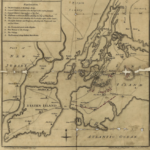
Plan of the Attack on the Provincial Army on Long Island,” John Bowles, 1776. Library of Congress, via Wikimedia Commons. Public domain.
When the Declaration of Independence was adopted on July 4, 1776, the Continental Army was already preparing for a British attack on New York, a city of geographical importance because of its harbor and its position along the Hudson River.
British control could divide New England from the other states and give the Royal Navy a base for future operations.
Washington did not know exactly where the British would strike. His forces were divided on both sides of the East River, with defensive positions extending from Manhattan and Governors Island to Brooklyn Heights. According to the National Park Service, Washington had about 19,000 troops distributed across the area while more than 32,000 British and German troops prepared to oppose them.
Many Continental soldiers had little battlefield experience. They faced a professional force supported by one of the most powerful navies in the world. The coming battle would be the first major engagement fought by the newly independent United States.
How the British Broke the American Line
The main fighting began a day like this one, August 27, 1776, on the western end of Long Island, in what is now Brooklyn. American defenses relied partly on several passes through the wooded Heights of Guan. One of them, Jamaica Pass, was left dangerously exposed.
British commanders recognized the opening. During the night, a large force moved through the pass and appeared behind the American left. Other British and German troops kept the defenders occupied from the front, leaving the Continental positions caught between coordinated attacks.
The line began to collapse. Some soldiers escaped toward the fortifications at Brooklyn Heights. Others became disoriented in the wooded terrain or were captured during the retreat. The U.S. Army Center of Military History estimates that around 300 Americans were killed. More than 1,000 were captured, while the number wounded remains unknown.
The British had won decisively, but parts of the Continental Army continued fighting to keep the defeat from becoming complete destruction.
The Marylanders Buy Time
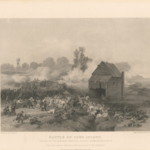
Battle of Long Island, Retreat of the Americans Under General Stirling Across Gowanus Creek,” James Smillie. New York Public Library, via Wikimedia Commons. Public domain.
Near Gowanus Creek, troops from the 1st Maryland Regiment and the Delaware Regiment faced a desperate situation. British forces were closing the route back to Brooklyn Heights. If the road was cut, many more Americans could be surrounded.
General William Alexander, known as Lord Stirling, led Maryland and Delaware troops against a much larger force near the Cortelyou House, later remembered as the Old Stone House. Their attacks bought time for other soldiers to cross the marshy creek and reach the defensive lines.
The Maryland troops became known as the Maryland 400, although the name does not represent a precise count of everyone who fought there. Their stand came at an enormous cost. Many were killed or captured, and the regiment was nearly destroyed. Stirling also surrendered.
Their sacrifice did not reverse the battle. It accomplished something just as urgent: it gave other soldiers time to escape. The Battle of Long Island is remembered partly because of that distinction. A unit can lose ground and still protect the larger mission through discipline and courage.
A Defeated Army With Nowhere to Go
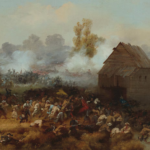
Battle of Long Island,” Alonzo Chappel, 1858, via Wikimedia Commons. Public domain.
The survivors gathered behind the earthworks at Brooklyn Heights. Their position offered temporary protection. The British held the surrounding ground, while the Royal Navy controlled the waterways. About 9,000 American troops were confined with the East River behind them.
British commander General William Howe chose to begin siege operations instead of immediately attacking the fortifications. The decision avoided the kind of costly frontal assault the British had experienced at Bunker Hill. It also gave Washington a narrow window in which to act.
Remaining in Brooklyn could mean surrender. Attempting to fight through the British lines could destroy what remained of the army. Washington called a council of war on August 29, 1776, and his commanders agreed that Long Island had to be abandoned.
By leaving, they accepted defeat. But also recognized that preserving the Continental Army was the most important thing.
The Evacuation Across the East River
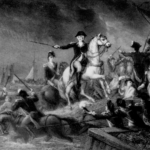
Washington’s Retreat at Long Island,” engraving by James Charles Armytage after Michael Angelo Wageman. National Archives and Records Administration, via Wikimedia Commons. Public domain.
Washington ordered every available boat in the area brought to the Brooklyn waterfront. The evacuation depended on soldiers from Massachusetts regiments that included experienced sailors and fishermen. Under cover of darkness, they began ferrying the soldiers across while preserving the army’s artillery and as much equipment as possible.
Secrecy was the key. Campfires remained burning so the British would believe the American positions were still occupied. Wagon wheels were muffled, and soldiers were ordered to remain quiet as they moved toward the water. General Thomas Mifflin commanded the rear guard that held the fortifications while the rest of the army withdrew.
The weather also changed the outcome. A nor’easter kept British ships from moving into the East River. As daylight approached, a heavy fog settled over Brooklyn and concealed the final stages of the evacuation. By the morning of August 30, 1776, the army had reached Manhattan with its artillery.
The operation demanded moving in silence through deep mud before boarding boats in darkness. Even while retreating, they maintained the appearance of an occupied position until the withdrawal was nearly complete.
Why the Battle Still Matters 250 Years Later
The British victory at Long Island gave them control of New York City, which they held for the remainder of the war. The Continental Army would endure further defeats and a difficult retreat across New Jersey before Washington restored momentum at Trenton and Princeton.
Long Island revealed serious weaknesses in American planning and battlefield experience. Washington had divided his forces, underestimated the danger at Jamaica Pass, and reinforced a position that could easily be isolated. The retreat showed that he could change course before the mistakes became fatal.
The Marylanders and Delawareans demonstrated what a smaller force could accomplish by protecting others. The sailors of the Massachusetts regiments turned civilian experience into military capability. The entire army showed that order could be restored after confusion.
The modern U.S. Army traces its beginning to the Continental Army. Its history includes celebrated victories and carries the memory of difficult retreats. It remembers the units that held their ground so others could continue.
Carrying the Story Forward

Military history survives through the symbols units choose to preserve. A unit’s insignia and motto can carry that history. Campaign honors and Army challenge coins give it another physical form, connecting current soldiers with the people who carried the same unit identity before them.
A meaningful commemorative design does not have to celebrate a perfect victory. It can remember sacrifice or adaptation. It can also preserve a moment when a unit protected something larger than itself. Those stories deserve the same care as the most famous triumphs.
If your unit is ready to preserve its own history, Embleholics can help create a custom Army challenge coin that reflects its mission and legacy. Request a free quote and begin turning that story into a design soldiers can carry forward.
Recent Posts