
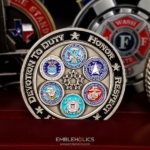
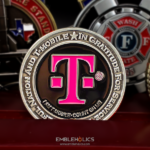
A military appreciation coin is given by a company to veterans and service members, and it is the one category of coin that has to work without any military insignia on it. A company has no right to use a service’s emblem, and the people receiving the coin served in different branches and different units, so there is no single insignia that would be correct anyway. What is left is the company’s own mark, general devices, and words. This T-Mobile coin is built from exactly that.
Why an Appreciation Coin Avoids Unit Insignia
This is the part most companies do not know before they start, and it is better to know it at the brief stage than after a proof.
Service emblems are trademarks, and commercial use needs a license. Each armed service owns its name, seal, emblem and insignia and runs its own trademark licensing program. The Marine Corps states it plainly: commercial use of its trademarks, including reproduction on merchandise, is prohibited unless the producer completes a license agreement, and the Eagle, Globe and Anchor, the seal, the name and the initials are the exclusive property of the service. The Army and the Air Force run equivalent programs.
Official markings must not imply endorsement. Federal law and service policy prohibit using official markings in a way that suggests a service endorses a private company or its products. A corporate logo sitting next to a service emblem on the same coin is exactly the impression those rules exist to prevent.
And any one insignia excludes almost every recipient. Even with a license, a coin carrying one branch’s emblem is wrong for the Army veteran, the sailor and the airman standing next to the Marine. Appreciation coins go out to a mixed audience by definition.
If your company wants to use a service’s name or emblem, the route is that service’s trademark licensing office, before the artwork stage. We produce from the artwork a customer supplies, we rely on the customer to hold the right to supply it, and we do not grant permission on anyone’s behalf.
What Goes on the Coin Instead
The absence of insignia is not a limitation once you see what is available.
- Your own marks. The company logo and wordmark are the one thing you unquestionably own, and on an appreciation coin they are also the point: the coin is a statement from the company.
- General devices that belong to nobody. An eagle, a flag, stars, a wreath, a ribbon, a star field. None of these is any service’s property, and all of them read as recognition without claiming affiliation.
- Words. This is where appreciation coins do most of their work, which is why so many of them are text-heavy. The sentiment has to be stated, because there is no insignia doing it.
Small Lettering Is the Real Design Problem
A text-led coin runs straight into the hardest thing to produce well at coin size, which is small lettering. This design carries a lot of it.
Two separate failures happen, and they have different causes.
Thin strokes do not fill. Metal flows into a die under pressure and the narrowest parts of the cavity are the last to fill. A light or fine-weight typeface at small size produces letters with soft or broken strokes, inconsistently from strike to strike.
Narrow recesses do not hold paint. If the lettering is to be painted, each letter is a channel that has to contain enamel without it spilling into the next one. Below a certain width that stops being reliable, and the text ends up looking blurred rather than crisp.
Four fixes, in the order worth trying them:
- Cut words. Always the best answer. Half the text at twice the size reads; all of it at half the size does not.
- Use a heavier weight. A bold or medium face has thicker strokes, which fill reliably and hold paint at smaller sizes than a light face can.
- Engrave rather than raise. Recessed letters keep crisper edges at small sizes than raised ones, which lose their corners in the strike.
- Increase the diameter. A few extra millimeters buys more legibility than any amount of artwork adjustment, and it is cheaper than a reprint.
One Coin for Every Branch
If you decide to name the branches on an appreciation coin, two things matter and both get noticed.
List all of them. There are six armed services, and the Space Force is the one most often left off a design written from an older template. An omission is read as an oversight at best.
Use a recognized order. The convention used for flag displays and ceremonies runs Army, Marine Corps, Navy, Air Force, Space Force, Coast Guard. There is more than one ordering in circulation, so confirm with whoever is approving the coin rather than defaulting to alphabetical, which looks like a spreadsheet decision.
When to Give It
Appreciation coins get handed out at hiring events, at employee resource group gatherings, to military and veteran customers, at a veteran employee’s work anniversary, and on Veterans Day.
One distinction is worth stating because companies get it wrong every year. Veterans Day honors people who served and are living. Memorial Day honors those who died in service. An appreciation coin is a Veterans Day object. Handing out a thank-you-for-your-service coin at a Memorial Day event is a misstep that veterans notice immediately, and it is entirely avoidable.
Design an Appreciation Coin for Your Company
Send your logo and the wording you want on the coin, and say who the recipients are. If you are undecided on wording, tell us, because the amount of text decides the diameter and the typeface weight.
Professional artwork is free with unlimited revisions, the minimum order is 50 coins, and nothing goes into production until you approve a digital proof. Standard production runs about 45 to 50 days after final artwork approval, rush production is available on many projects, and shipping within the continental United States is included. Embleholics is veteran-owned, SDVOSB and registered in SAM.gov. See more corporate challenge coins, another T-Mobile coin project, or guidance on putting a company logo on a challenge coin.
Coin Front
Coin Back
Frequently Asked Questions
What is a military appreciation coin?
A military appreciation coin is a coin a company or organization gives to veterans and service members as recognition rather than as a unit identifier. Because the giver is not a military organization and the recipients served in different branches, these coins are built from the company’s own marks, general patriotic devices and wording instead of unit or service insignia.
Can a company put military insignia on a challenge coin?
Not without a license. Each armed service owns its name, seal, emblem and insignia and runs a trademark licensing program, and commercial use on merchandise generally requires a written license agreement with that service. The Marine Corps, for example, prohibits commercial reproduction of its trademarks without one. Service policy also prohibits using official markings in a way that implies the service endorses a private company or product.
Why do corporate appreciation coins avoid unit insignia?
For two reasons. The licensing and endorsement rules above, and the practical one: a coin carrying a single branch’s emblem is wrong for every recipient who served in a different branch. Appreciation coins go to a mixed audience by definition, so a design that claims no affiliation works for everybody.
What can go on a coin instead of military insignia?
Your own logo and wordmark, general devices that belong to no service such as an eagle, a flag, stars, a wreath or a ribbon, and wording. Text does more of the work on an appreciation coin than on any other kind, because there is no insignia carrying the message.
What is the smallest lettering that works on a challenge coin?
It depends on stroke weight more than on height. Thin strokes are the last part of a die to fill, so a light typeface produces soft or broken letters, and if the text is painted, narrow recesses cannot hold enamel without it spilling. The fixes in order are to cut words, use a heavier weight, engrave the lettering rather than raising it, and increase the coin’s diameter.
Should lettering be raised or engraved on a coin?
Engraved, when the text is small. Recessed letters keep crisper edges, where raised letters lose their corners during striking and read as soft. Raised lettering works well at larger sizes and for short phrases where each letter is big enough to strike cleanly.
How should the branches be listed on an appreciation coin?
List all six, including the Space Force, which is the one most often missing from designs built on an older template. Use a recognized order rather than alphabetical. The convention used for flag displays and ceremonies runs Army, Marine Corps, Navy, Air Force, Space Force, Coast Guard, and since more than one ordering is in circulation it is worth confirming with whoever approves the coin.
Is an appreciation coin appropriate for Memorial Day?
No. Veterans Day honors people who served and are living, while Memorial Day honors those who died in service. A thank-you-for-your-service coin is a Veterans Day object, and handing one out at a Memorial Day event is a misstep veterans notice.