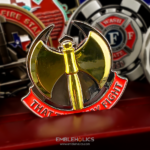
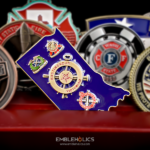
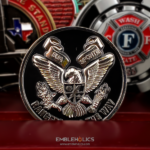
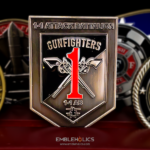
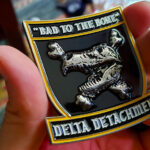
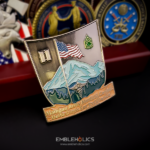
An Army medical challenge coin recognizes the people who staff a military hospital, clinic, or medical detachment rather than a line unit. This one was made jointly for Madigan Army Medical Center and a partner detachment at Joint Base Lewis-McChord, Washington. The coin is cut as a shield with a ribbon banner at its base, and the two organizations split the faces between them: the detachment’s mascot is sculpted on one side, and a carved and colored landscape standing in for Madigan’s setting fills the other.
A joint coin needs the faces divided before the artwork starts
The hardest part of a two-organization coin is not design, it is agreeing who gets what. When two units co-sponsor a coin, both arrive with a crest, a mascot, a motto, and a set of colors, and there is room for roughly half of that. Settle the split first and the design follows quickly. Leave it unsettled and the artwork cycles through revisions while the two parties negotiate through us, which is the slowest way to resolve it.
The split that works most often is one face each, as on this coin. Each organization owns a side completely, which avoids the compromise where both crests are shrunk to fit side by side and neither reads. Two other options are worth considering:
- Host and guest. One organization takes the front with its crest at full size, and the other appears on the reverse in a supporting position, usually with its name in the rim. This suits a coin where one unit is clearly the sponsor.
- Shared shape. Both organizations keep their emblems small but the coin’s outline comes from one of them, so the silhouette does the identifying. This works when the shape is distinctive enough to carry it.
Shields and ribbons cost outline, and buy recognition
A shield is the most common custom outline in military medicine, and the ribbon under it is what usually gets cut. A shield shape is clean, it is already associated with medical and heraldic insignia, and it gives a wide top for lettering with a tapering base that frames a mascot or a date. The ribbon banner adds a traditional finish, but it is also the thinnest part of the coin, so lettering inside it has to be short. One or two words will hold. A motto will not.
Plan the lettering around the taper. On a shield, the usable width shrinks as you go down, so the longest text belongs at the top and anything in the lower third should be a short line, a number, or nothing at all. A long unit title set across the base is the most common reason a shield coin looks cramped.
Carving texture rather than drawing it
The detail on the mascot side of this coin is carved, not printed. The sculpt carries skeletal texture, including small openings and irregular organic shapes, cut into the surface so the shadow does the work rather than a line drawing. That is the difference between a coin that looks sculpted and one that looks like a sticker: depth that changes as the coin tilts in the hand.
Texture needs a plain neighbor. A heavily carved element only reads if something next to it is smooth. On this coin the sculpted mascot sits against a clear field, and the landscape side keeps its carving to the terrain while the sky stays flat. Carving everything flattens the whole coin out, which is a counterintuitive but reliable result.
Color goes on last and selectively. The landscape side is both carved and colored, which is more expensive than either alone and only worth it where the color is carrying information, such as distinguishing forest from rock from water. A carved surface with no color often has more presence than a colored one with no carving.
Madigan at Joint Base Lewis-McChord
Madigan Army Medical Center is the Army’s hospital at Joint Base Lewis-McChord in Washington State, and one of the larger military medical facilities in the Pacific Northwest. It serves active duty service members, their families, and retirees across the region, and it trains military medical personnel as well as treating them.
We make a lot of coins for this base. Embleholics is a veteran-owned shop in Port Orchard, a short drive from Joint Base Lewis-McChord, and the commands there are among our closest customers. The Veterinary Readiness Activity Fort Lewis coin came from the same base, and we have produced coins across the military medical field, including the U.S. Public Health Service coin.
Starting a medical unit coin
Bring both crests, a decision on the split, and the outline you have in mind. If the coin is joint, having the two organizations agree on which face belongs to whom before we start saves more time than anything else in the process. We will come back with a shape drawing and a layout for both faces, showing where lettering falls against the taper, before anything is cut. You can see other Army challenge coins we have produced, or send your artwork through the free quote form.
Finished Coin (Front)
Finished Coin (Back)
Frequently Asked Questions
What is an Army medical challenge coin?
An Army medical challenge coin recognizes the staff of a military hospital, clinic, or medical detachment rather than a combat unit. Medical commands use them much as line units do, for recognition, for welcoming new staff, and for marking exercises and milestones. The designs usually draw on heraldic shapes such as shields and on the unit’s own crest and mascot.
How do two units share one challenge coin?
The cleanest method is one face each, so each organization owns a side completely and neither crest has to be shrunk to share space. Two other patterns work: a host-and-guest split, where one unit takes the front at full size and the other appears on the reverse or in the rim, and a shared-shape approach, where the coin’s outline comes from one unit so the silhouette does the identifying. Agree on the split before artwork starts, because that is where joint coins lose the most time.
Why are so many medical coins shield-shaped?
A shield is already associated with medical and heraldic insignia, it gives a wide top for a unit title, and its tapering base frames a mascot, a date, or a ribbon. It is also a straightforward outline to cut, which keeps the shape work affordable compared with a highly irregular profile.
How much text fits in a ribbon banner?
One or two short words. The ribbon under a shield is the thinnest part of the coin, so lettering inside it sits at the smallest size anywhere on the design. A motto or a full unit title will not survive there. Put long text across the wide top of the shield and keep the lower third to a short line or leave it clear.
Does carved texture cost more than printing a design?
Yes, because the detail is cut into the die rather than applied to the surface, and it is usually worth it. Carved texture changes as the coin tilts in the hand, which is what separates a coin that looks sculpted from one that looks like a printed sticker. The trade-off is that carving needs a plain surface beside it to read against, so carving every part of a coin flattens the overall effect.
Should a coin be carved, colored, or both?
Both costs more than either, so use color where it carries information rather than everywhere. On a landscape, color distinguishes forest from rock from water and earns its place. On a crest that is already legible in relief, color often adds expense without adding clarity. A well-carved coin with no color frequently has more presence than a colored one with no carving.
Where is Madigan Army Medical Center?
Madigan Army Medical Center is the Army’s hospital at Joint Base Lewis-McChord in Washington State, serving active duty service members, military families, and retirees across the Pacific Northwest and training military medical personnel. It is one of the larger military medical facilities in the region.
More Army Projects