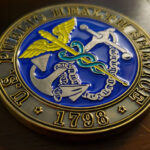
A Public Health Service challenge coin belongs to a uniformed service that most people do not know exists. USPHS officers wear uniforms, hold Navy-style ranks and serve under the Surgeon General, and they are not military. That shapes what belongs on their coins. This one is a dark brass round coin with the USPHS emblem and the American flag picked out in gloss, and a ring of individual officers’ names engraved around the reverse.
A Uniformed Service That Is Not Military
The United States has eight uniformed services. Six are armed forces. The other two are the Commissioned Corps of the Public Health Service and the Commissioned Officer Corps of the National Oceanic and Atmospheric Administration, and those two are also the only ones made up entirely of commissioned officers, with no enlisted ranks at all.
Three facts follow that matter when a coin is being designed.
- The ranks are naval. The Corps uses the same commissioned officer structure as the Navy and Coast Guard, ensign through admiral, O-1 to O-10, and officers hold a naval rank and a professional title interchangeably. A USPHS coin that looks naval is not borrowing from the Navy; the ranks genuinely are those ranks.
- Officers are noncombatants. They are classified as noncombatants unless directed by the President to serve as part of the military, so weapons, warfare devices and combat imagery do not belong on these coins.
- It is a federal service, not an armed force. Its emblem and seals are federal marks governed by agency policy rather than by the armed services’ trademark licensing programs, so approval for using them runs through the agency.
The Corps sits within the Department of Health and Human Services, and its officers work in public health, clinical care, research and engineering, including in underserved communities.
Why a Health Service Wears a Fouled Anchor
The Corps’ device is a fouled anchor with a caduceus, which looks like an odd pairing for a health service until you know where the service came from. It is the single best thing to understand before designing a coin for these officers.
The Public Health Service descends from the marine hospitals established in 1798 to care for sick and disabled merchant seamen. In 1871 those hospitals were consolidated into the Marine Hospital Service, and the fouled anchor and caduceus design dates from that reorganization. Congress formally established the modern Commissioned Corps in 1889, and the service was renamed the Public Health Service in 1912 as its remit grew to include quarantine authority and research.
So a public health officer working a thousand miles from any coast wears an anchor because of a law about merchant sailors passed in 1798. The naval ranks come from the same place. That lineage is the most interesting thing a USPHS coin can carry, and it is almost always left off in favor of a generic medical symbol.
A Ring of Officers’ Names
The reverse of this coin carries individual officers’ names engraved in a ring, and the client was right that it is the hard part. A roster of names is the most constrained thing you can put on a coin, for one reason: every other element on a coin is negotiable and a person’s name is not.
You cannot shorten a name to make it fit. You cannot abbreviate one person and not another. You cannot drop one. That single fact inverts the normal design process.
Four rules follow.
Work backwards from the names. Count them, measure the longest, and let that decide the type size, which then decides the diameter. On every other coin the diameter comes first and the content is fitted into it. On a roster coin the content is fixed and the coin has to grow to hold it.
Plan for names of very different lengths. A roster will contain a four-letter surname and a fifteen-letter one. Setting every name to fill the same arc makes the type size jump around and looks like an error. The better approach is one consistent letter size with a separator device, a dot, a star or a small diamond, between names, so the gaps absorb the difference instead of the letters.
Settle the order before artwork, and have it signed off. Alphabetical, by seniority, by date of commissioning. This is a decision with feelings attached and it belongs to the customer, not to the manufacturer. Getting it changed after a proof is easy. Getting it changed after a strike is not.
Engrave rather than raise. Cut letters hold crisper edges at small sizes, and on a roster the type is already going to be as small as it can safely be.
When Not to Put Names On
The honest counterpart to all of that: a roster freezes the coin to a moment.
If the group is a fixed cohort, a deployment team, a class, a founding group, a response that is now over, names are the right choice and the coin becomes a record that cannot be reissued. If the group changes, people rotate in and out, or more will join next year, names will date the coin within months and the next order cannot reuse the artwork.
Where the membership moves, the usual answer is to keep the coin general and put the names somewhere else: on a presentation card, an engraved plate, or the inside of a case.
Gloss as a Highlight, Not a Finish
The coin is dark brass with glossy paint applied only to the USPHS emblem and the American flag. That is gloss used as emphasis rather than as the coin’s finish.
A fully glossy coin has no hierarchy, because every surface reflects equally. Restricting gloss to two elements on a darker, less reflective field makes those two the brightest things on the coin, so they are read first without being any larger. It is the same logic as a single accent color, applied to shine instead of hue, and on a coin with a dense ring of engraved text it is particularly useful, because the text stays quiet while the emblem carries the attention.
Order a Coin for Your Corps or Agency
Send your agency emblem in the approved form, and if the coin is to carry names, send the full list and the order you want them in. Tell us if the list might still change, because that decides whether the names belong on the coin at all.
Professional artwork is free with unlimited revisions, the minimum order is 50 coins, and nothing goes into production until you approve a digital proof. Standard production runs about 45 to 50 days after final artwork approval, rush production is available on many projects, and shipping within the continental United States is included. Embleholics is veteran-owned, SDVOSB and registered in SAM.gov. See more US government challenge coins, a military medical center coin, or EMS challenge coins.
Frequently Asked Questions
What is a Public Health Service challenge coin?
A Public Health Service challenge coin is a coin for officers of the United States Public Health Service Commissioned Corps, a uniformed service within the Department of Health and Human Services. The designs usually carry the Corps’ fouled anchor and caduceus emblem, and because the Corps uses naval ranks, these coins often resemble Navy coins in style.
Is the US Public Health Service one of the uniformed services?
Yes. The United States has eight uniformed services, six of which are armed forces. The Public Health Service Commissioned Corps and the NOAA Commissioned Officer Corps are the other two, and they are also the only two made up entirely of commissioned officers with no enlisted ranks.
Do USPHS officers hold military ranks?
They hold the same commissioned officer rank structure as the Navy and Coast Guard, from ensign through admiral, O-1 to O-10, and they use a naval rank and a professional title interchangeably. The ranks are real ranks within a uniformed service rather than honorary equivalents.
Is the Public Health Service Commissioned Corps part of the military?
It is a uniformed service but not an armed force. Its officers are classified as noncombatants unless the President directs them to serve as part of the military. For coin design that means weapons and combat imagery are inappropriate, even though the ranks and some of the devices are naval in origin.
Why does the Public Health Service use an anchor?
Because the service descends from the marine hospitals established in 1798 to care for sick and disabled merchant seamen. Those hospitals were consolidated into the Marine Hospital Service in 1871, and the fouled anchor and caduceus emblem dates from that reorganization. The naval rank structure has the same origin.
When was the Public Health Service Commissioned Corps established?
Congress formally established the modern Commissioned Corps in 1889. The service traces back to the marine hospital system of 1798, was consolidated as the Marine Hospital Service in 1871, and was renamed the Public Health Service in 1912 as its responsibilities grew to include quarantine authority and research.
Can officers’ names be engraved around a challenge coin?
Yes, and it is the most constrained thing you can put on a coin, because a name cannot be shortened, abbreviated for one person only, or left out. Count the names and measure the longest first, then let that set the type size and the diameter, rather than choosing a size and trying to fit the list into it.
How do you fit names of different lengths in a ring on a coin?
Keep one consistent letter size and put a separator between names, such as a dot, a star or a small diamond, so the gaps absorb the difference in length. Stretching each name to fill an equal arc makes the type size vary visibly and reads as a mistake. Engrave the lettering rather than raising it, since cut letters hold crisper edges at small sizes.
More EMS Projects