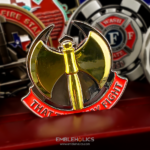
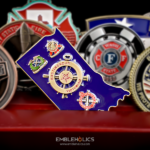
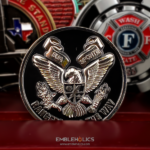
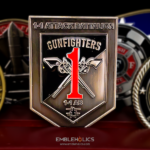
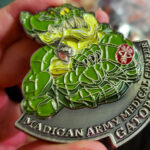
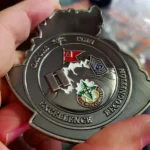
A mascot challenge coin is cut to the shape of the mascot rather than printed with a picture of it. This one was made for Madigan Army Medical Center at Joint Base Lewis-McChord, Washington, whose people are known as the Gators. The coin is the alligator: a muscular cartoon figure with its arms crossed, biting down on a dog tag chain, with the medical center’s insignia worked into both faces.
Cut the mascot, do not stamp it
The difference between a mascot coin and a coin with a mascot on it is the outline, and it is the whole decision. A round coin with an alligator in the middle is a unit coin. A coin shaped like the alligator is the mascot, sitting in someone’s hand. People react differently to the second one, and they keep it.
It also solves a problem that round mascot coins always have. A character drawn to stand upright does not fit a circle. Placing one inside a round field either leaves large empty areas above and below, or forces the figure to be shrunk until the face stops reading. Cutting to the figure removes the conflict entirely.
The trade-off is that you lose the rim. No circular band means nowhere obvious for a unit name, a motto or a date. On this coin the insignia and text have to find flat passages within the body of the figure, which has to be planned from the first drawing rather than added at the end.
What a cartoon outline needs to survive
Cartoon figures are full of exactly the features that break on a struck coin. Tails, snouts, raised fists, ears, spikes along a back. Each one is a thin projection, and thin projections catch on pockets, bend when dropped, and chip their plating first.
What we change, and why it does not show:
- Thicken the extremities slightly. A tail or a snout gains a fraction of a millimeter. Invisible side by side with the original drawing, and it roughly doubles how much abuse the coin takes.
- Soften the tip radius. Sharp points become very slightly rounded. This is mostly about how the coin feels in a pocket, which is where it will live.
- Fold limbs into the body. This is why crossed arms work so well on a mascot coin. An arm held out from the body is a projection; an arm folded across the chest is part of the silhouette. The pose on this coin is not accidental.
- Simplify the back edge. A row of small spikes or scales reads as texture at coin size anyway, so cutting them as a gentle wave rather than as individual points loses nothing and removes a dozen fragile tips.
Expect the outline to be redrawn. A mascot drawn for a logo, a wall or a shirt has not had to survive being carried, and the version that gets struck is almost always a slightly adapted one. We will show you both so you can see what changed.
Keeping the face readable
On a mascot coin the face is the whole thing, and it is usually the smallest part of the design. If the figure is full-body, the head might be a fifth of the coin’s height, which puts the eyes and mouth at a scale where fine lines disappear.
Two ways to protect it. The first is to build the face in relief rather than in line, so the brow, snout and jaw sit at different depths and light defines them. The second, if the face still will not hold, is to change the crop: a head-and-shoulders mascot coin gives the face four or five times the area a full-body one does. Plenty of the best mascot coins are just the head.
Why mascots work for medical units
A hospital’s formal heraldry is necessarily serious, and a mascot does something the crest cannot. Military medical organizations carry a heavy institutional identity, and their official insignia reflect it. A mascot gives the same people an identity they chose rather than inherited, and it is usually the one they actually use with each other.
It also travels better as a gift. A crest coin handed to a visitor says what the organization is. A mascot coin says what it is like. For recognition within a unit, where everyone already knows the formal identity, the mascot is often the more meaningful of the two.
Madigan has done both, and the shield-shaped Madigan coin we produced takes the formal route for a joint project. Running a formal coin and a mascot coin side by side is a common and sensible arrangement: one for presentation, one for the people.
Madigan at Joint Base Lewis-McChord
Madigan Army Medical Center is the Army’s hospital at Joint Base Lewis-McChord in Washington State, serving active duty service members, military families and retirees across the region. It is also a teaching and research institution, running clinical research and treating traumatic brain injury and post-traumatic stress through its Intrepid Spirit Center.
It is also close to us. Embleholics is a veteran-owned shop in Port Orchard, a short drive from the base, and commands at Lewis-McChord are among our regular customers. The Veterinary Readiness Activity Fort Lewis coin came from the same installation.
Ordering a mascot coin
Send the mascot artwork and tell us whether you want full body or head only. If you are unsure, send it and we will show you both at actual size, because the decision is much easier to make looking at the two than describing them. We will flag every part of the outline we propose to adjust and explain why. You can see more Army challenge coins we have produced or send your artwork through the free quote form.
Finished Coin (Front)
Finished Coin (Back)
Frequently Asked Questions
What is a mascot challenge coin?
A mascot challenge coin is cut to the outline of the mascot itself rather than being a round coin with the mascot printed in the middle. The silhouette becomes the identity, so the coin reads as the mascot in the hand. It also avoids the problem that an upright character never fits comfortably inside a circle.
Will a cartoon mascot survive being struck as a coin?
Yes, with small adjustments to the outline. Tails, snouts, raised limbs and spikes are thin projections that catch, bend and lose plating first, so we thicken extremities slightly, soften tip radii, fold limbs into the body where the pose allows, and simplify rows of small points into a continuous edge. The changes are invisible beside the original drawing and roughly double the coin’s durability.
Where does the unit name go on a mascot-shaped coin?
Into flat passages within the figure, which has to be planned from the first drawing. Cutting to a shape means losing the rim, and the rim is where a round coin normally carries its name, motto and date. Decide what text is essential before the outline is finalized rather than trying to add it afterwards.
Should the coin show the whole mascot or just the head?
It depends on whether the face holds at size. On a full-body figure the head might be a fifth of the coin’s height, which can push the eyes and mouth below what will read. Building the face in relief rather than line helps, and if it still will not hold, a head-and-shoulders crop gives the face four or five times the area. Many of the best mascot coins are just the head.
Can you use our existing mascot artwork?
Yes, though expect it to be adapted. A mascot drawn for a logo, a wall or a shirt has never had to survive being carried in a pocket, so the struck version is usually a slightly modified outline. We will show you the original and the adjusted version side by side so you can see exactly what changed and approve it.
Should a unit have both a formal coin and a mascot coin?
It is a common and sensible arrangement. A crest coin says what the organization is and suits presentation to visitors; a mascot coin says what it is like and tends to mean more for recognition within the unit, where everyone already knows the formal identity. Madigan has both.
Where is Madigan Army Medical Center?
Madigan Army Medical Center is the Army’s hospital at Joint Base Lewis-McChord in Washington State, serving active duty service members, military families and retirees across the region. It is also a teaching and research institution, conducting clinical research and treating traumatic brain injury and post-traumatic stress at its Intrepid Spirit Center.
More Army Projects