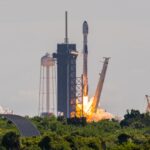
We’ve created several custom commemorative coins for SpaceX and many other business partners. That’s why we’re totally into what’s going on over there, and the bright future of space travel and AI merging together. The SpaceX IPO and merger with xAI represents a sea change in how an aerospace company is seen by the market, investors, and the world at large.
SpaceX going public will be the first time public markets are asked to price something that doesn’t fit neatly into an “aerospace company” box anymore. It’s launch. It’s orbital infrastructure. It’s a communications network. And now—post–xAI acquisition—it’s a serious bet that AI compute power belongs in space.
Why? Because Elon Musk believes the next era of space progress gets unlocked by scale: scale of lift, scale of bandwidth, scale of manufacturing, and scale of compute.

SpaceX’s IP has the potential to reshape how the world funds, values, and competes in space. It also forces a simple question: what is SpaceX becoming as it scales launch, networks, and now AI-driven infrastructure?
Let’s break down what the SpaceX IPO could mean, what the xAI integration changes, why the “mission shift” reads as a natural evolution, and why the Moon chapter is heating up.
SpaceX Scaled by Stacking Real Milestones
SpaceX’s story is a sequence of executed chapters—each one expanding what the company can do next.
- Falcon 9 (reusability at scale): The workhorse era—routine landings, rapid reuse, and a launch cadence that turned “spaceflight” into an operational system.
- Crew Dragon Demo-2 (DM-2): The moment commercial human spaceflight became real in the modern era—NASA-certified capability, real astronauts, real stakes.
- Starlink scaling phase: A shift from “launch” to “infrastructure”—a global communications layer in orbit that turns rockets into a deployment engine.
- Manufacturing tempo (15-second stages in one month): Production rate as competitive advantage—repeatability, throughput, and the kind of cadence that public markets actually understand.
- Raptor 3 / Starship propulsion evolution: The engine program as the unlock—higher performance, manufacturability, and reliability aimed at making heavy-lift and rapid iteration sustainable.
- xAI acquisition (February 2026): The newest milestone—AI added to the stack, aligning launch + network + compute into one integrated platform.
That’s the IPO connection: public markets price systems with compounding capability—launch, infrastructure, manufacturing, propulsion, and now AI.
IPO reality check: what the 2026 reports imply, and why timing matters
Multiple reports have pointed to a SpaceX IPO window around 2026, with very large valuation targets being discussed publicly.
Those IPO numbers land differently after the February 2026 xAI acquisition, because the merger documents and follow-on reporting describe a combined SpaceX–xAI valuation around $1.25T, with SpaceX valued around $1.0T and xAI around $250B at the time of the tie-up.
This is a wildly different IPO from any other in history — and it’s not just the valuation.
Starlink as the Center of Gravity
Starlink reframes the story from SpaceX as a “launch company”, like Boeing, to an “infrastructure operator.” The company’s launch capability becomes the engine that builds and maintains the worldwide network of satellite communications, and the network becomes the recurring value layer that the market understands.

Public-Market Pressure Becomes Part of the Mission
A SpaceX IPO introduces a new force: quarterly scrutiny and broader disclosure. That reshapes how risk, iteration, and pacing get communicated externally—especially during a period when SpaceX is trying to scale Starship, expand Starlink, and now integrate AI-driven infrastructure at the platform level.
xAI Acquisition: Confirmed
SpaceX’s acquisition of xAI in early February 2026 changes the map. It positions SpaceX as a company building a combined stack of lift + network + compute, with “orbital compute / space data centers” emerging as part of the strategic direction described in the report.
This is massive. SpaceX will no longer just offer Starlink internet, it will offer AI compute power at a much lower cost per token than anything on Earth, which is severely constrained by energy access.

Why this Matters Strategically
This is the logic chain:
- SpaceX already owns the world’s most active launch pipeline.
- Starlink builds distribution in orbit: global connectivity at scale.
- xAI adds a mission-level reason to scale compute far beyond Earth-bound data centers.
- Combine the pieces, and you get a vertically integrated platform where SpaceX can deploy compute as a constellation—launch it, network it, upgrade it, replace it, and expand it like infrastructure.
Here’s why the “AI satellites” idea clicks for people (including Musk), even if the execution is brutally hard:
- Power becomes the unlock: Space-based solar is close to constant, with no clouds and higher solar intensity than on the ground. SpaceX’s own filings emphasize near-continuous solar power as the core advantage for “orbital data centers.”
- Cooling changes shape: You lose air for convection, but you gain vacuum and radiative cooling—meaning the design leans on large radiator surfaces to dump heat. SpaceX’s application explicitly talks about radiator panels.
- Night isn’t the same problem as on Earth: Many orbits still pass through eclipses, so some storage and power management are still required. The pitch is that power generation can be far more predictable and average utilization far higher than terrestrial data centers.
- Hardware stability has improved: Modern compute hardware is far more robust than it used to be, but space adds radiation, charging, thermal cycling, and micrometeoroids. The advantage is operational control: if you can launch often and cheaply, you can refresh the constellation instead of babying it for a decade.
Musk and recent reporting describe the scale as extreme: filings and coverage cite a plan that could involve up to a million satellites operating as orbital data centers, linked by high-bandwidth optical inter-satellite links, explicitly framed as a path to massive space-based AI compute capacity.

Reporting on Musk’s remarks around the deal highlights the premise that space-based compute could become economically compelling, with benefits tied to power and cooling at scale.
And it’s not just about generating your own silly videos. Musk plans to deploy large-scale AI to solve the problems of interstellar travel and explore the universe, bringing Grok truly into its namesake (“Grok” is derived from Stranger in a Strange Land, a book by Robert Heinlein published in 1961. It’s a Martian term that means “to understand everything.”)
Mission Evolution: From Mars to Space Computing Power
SpaceX’s Mars ambition remains the narrative that recruits talent and sets the ceiling. The operational center of gravity has moved toward infrastructure-first, because infrastructure funds the future and builds the capabilities that future missions require.
This evolution reads cleanly:
Step 1: Own Access to Orbit
SpaceX’s ambitious Starship project pushes lift and cost curves—toward Musk’s stated endgame of airline-like operations, with Starship ultimately supporting on the order of 10,000 launches per year to build out orbital infrastructure at massive scale.
That’s right, they plan on launching 10,000 Starship missions into space!
Step 2: Build the Orbital Network
Starlink turns “space activity” into a persistent service layer—a always-on orbital network that can move data between satellites, ground stations, ships/aircraft, remote sites, and (in the future) other space assets.
In practical terms, that means:
- AI can “relay through Starlink”: An orbital compute node (or any satellite) can push data across Starlink’s inter-satellite laser links and downlink it wherever bandwidth is available, rather than waiting to pass over a specific ground station.
- Latency can improve in specific cases: Because Starlink is in low Earth orbit, signal travel time to/from orbit is lower than older geostationary satellite systems. For remote regions (or mobile users at sea/air), Starlink can deliver much lower latency than traditional satcom.
- Latency isn’t automatically better than fiber: For many ground-to-ground routes, terrestrial fiber is still hard to beat. The win case is global coverage, mobility, and routing flexibility—plus specialized long-distance paths where orbital routing can be competitive.
- Edge compute reduces “backhaul”: If some inference/training tasks run on-or-near the satellites, you can process data closer to where it’s collected and transmit only the results—saving bandwidth and time.

Step 3: Add Compute to the Domain
With xAI in the stack, the direction becomes clear: AI doesn’t sit beside the mission—it becomes part of how the system runs and how the next breakthroughs get attacked.
How much compute, and how fast? In the most aggressive version of the plan described in reporting around the xAI acquisition and related filings, Musk talks in terms of throughput to orbit rather than a single “GPU count.”
In reporting, this roadmap is framed as using orbit-scale infrastructure to accelerate breakthroughs—including tackling physics and engineering constraints tied to the long arc of deep-space travel.
That’s the framing worth using in the article: infrastructure is the machine that makes the frontier achievable.
Once deployed, a million AI satellites will work in conjunction with researchers to improve our understanding of how the universe works and push the boundaries of physics and space travel beyond what is currently knowable—a sea change in understanding the way the universe works.
The Moon: a Stepping-Off Point
SpaceX’s role in Artemis and Starship Human Landing System work keeps the Moon chapter hot, and recent reporting has covered discussion around simplifying aspects of the Artemis 3 architecture to move faster.
What is Artemis? A crewed, 30-day mission to the south pole of the moon, led by NASA and supported by multiple agencies, all working in unison.
Why the Moon, Specifically?
The Moon is the closest place in space where you can build and stress-test the full stack SpaceX needs for the long game: high-cadence launches, in-space refueling, long-duration operations, deep-space navigation, and sustained logistics.
Why it connects to the SpaceX IPO:
- The Moon is a public scoreboard: It’s visible, politically relevant, and hard to spin. Results (or delays) become headline-level signals.
- It demands operational maturity: In-space refueling, repeatability, mission assurance, and the ability to run complex campaigns without hero-mode.
- It validates the manufacturing and logistics flywheel: High launch cadence only matters if vehicles, engines, and second-stage/ship production can keep up.
- It’s a proving ground for Mars capability: Anything that works at lunar distance (refueling, radiation and thermal management, autonomy, comms, fault tolerance) becomes a direct input to Mars timelines.
- It sets up deep-space infrastructure: The Moon is a staging point for relays, navigation aids, and potentially compute/communications nodes that extend beyond Earth orbit.

AI Satellites Shot into Deep Space?
If the “compute-in-space” plan starts in low Earth orbit (LEO), the Moon becomes the next logical step for expanding the envelope: pushing communications relays and compute-enabled assets farther out, testing autonomy under greater latency, and building resilient routing beyond Earth’s immediate neighborhood. The aim isn’t to stream TikToks from lunar space—it’s to build a network and compute layer that supports exploration-grade operations.
Build the Rocket Tech to Reach Mars
The Moon is where SpaceX can practice the choreography Mars requires at scale: rapid reuse, orbital refueling, multi-launch campaign planning, surface ops planning, and recovery/maintenance cycles. A lunar program forces the engineering into reality, then forces it to repeat.
Manufacturing on the Moon/Mars
Mars settlement requires manufacturing capability on-site—starting small (repairs, spares, tools), then scaling toward producing propellant, structures, and eventually major components. The Moon chapter is the closest operational training ground to develop the reliability, logistics discipline, and autonomous systems that make off-world manufacturing plausible.
Bottom line: the Moon is where SpaceX can turn big-theory into repeatable practice—and repeatable practice is what investors, partners, and the broader space industry treat as real.
What a SpaceX IPO Could Mean for the Space Industry
A SpaceX IPO pulls capital and attention toward a new category: space as infrastructure. It sets a new baseline for what “serious” looks like in this industry—cadence, vertical integration, and cost curves that force everyone else to answer uncomfortable questions. It also accelerates the race to build durable systems in orbit: communications, navigation, in-space logistics, and services that keep working when the map changes.
It also spotlights how uncommon SpaceX’s AI posture is inside aerospace. The big players are absolutely investing in AI—autonomy, manufacturing, mission software, defense applications—but they’re doing it inside traditional program structures. SpaceX is tying AI directly to its space stack and talking about scaling compute as part of the orbital infrastructure itself. That combination is rare.
Commemorate your Company’s Milestones
The teams building hard things build culture through milestones. First successful run. First deployment. First major production tempo win. First time you did in a month what used to take a quarter.
That’s exactly where Embleholics’ challenge coins belong: proof of chapter completion—a physical marker that the team earned the win. If you’re building a company that operates at a higher standard, your commemoratives should look like they belong there.
Embleholics builds mission-grade challenge coins for organizations that do real work and want the milestone to last.

Recent Posts