In the heart of Mogadishu, Somalia, on October 3, 1993, a mission unfolded that would become one of the most recognized U.S. military operations of the era: Operation Gothic Serpent. Spearheaded by elite U.S. forces, the operation aimed to capture key lieutenants of Somali warlord Mohamed Farrah Aidid. What followed was an intense and tragic urban battle that tested leadership, strategy, coordination, and courage.
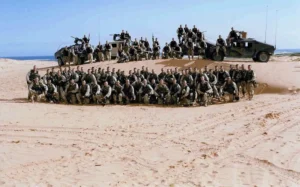
Bravo Company, 3rd Battalion of the 75th Ranger Regiment in Somalia, 1993.
The Objective and the Stakes
The mission was part of a broader UN effort to stabilize Somalia after years of civil war and famine. Aidid, whose militia had attacked UN peacekeepers, was considered a primary obstacle to the operation. Task Force Ranger brought together personnel from several elite U.S. military units, including Delta Force, Army Rangers from the 75th Ranger Regiment, the 160th Special Operations Aviation Regiment (Night Stalkers), Navy SEALs, and Air Force Pararescuemen.
Their goal was straightforward in theory: conduct a rapid raid to capture two of Aidid’s top lieutenants. But urban warfare rarely goes exactly as planned.
The Battle of Mogadishu Begins
On the afternoon of October 3, Task Force Ranger deployed into the Bakara Market area of Mogadishu. The targets were captured, but resistance from Aidid’s militia escalated rapidly. Two MH-60 Black Hawk helicopters were shot down by RPGs, triggering an urgent shift in the mission toward securing the crash sites and rescuing the crews.
What followed was an extended firefight through narrow streets and hostile territory. American troops fought under sustained small-arms and RPG fire while attempting to secure crash sites, protect the wounded, and evacuate personnel.
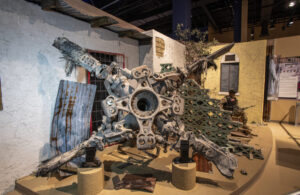
The rotor of Super 61 on display at the U.S. Army Airborne and Special Operations Museum.
Extraordinary Acts of Valor
Among the most remembered actions from the battle were those of Delta Force snipers Master Sergeant Gary Gordon and Sergeant First Class Randy Shughart. When one of the crash sites came under overwhelming fire, Gordon and Shughart volunteered to insert near the site to defend the crew.
Outnumbered and under intense fire, they defended the wounded pilot Michael Durant. Both were killed in action and were posthumously awarded the Medal of Honor.
Their actions, along with those of many others involved in the battle, became an enduring part of the history and legacy of Operation Gothic Serpent.
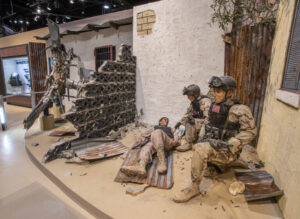
This display at the U.S. Army Airborne & Special Operations Museum portrays Shughart and Gordon defending the crash site while protecting an injured Michael Durant.
The Human Cost and Global Impact
By the end of the battle, 18 American soldiers had lost their lives and more than 70 were wounded. Somali casualties were estimated in the hundreds. Images from the aftermath reached the American public and dramatically changed perceptions of U.S. involvement in Somalia.
The operation had immediate and long-term consequences. U.S. forces ultimately withdrew from Somalia in 1994, while the Battle of Mogadishu became an important case study for military planners examining urban combat, intelligence, force protection, inter-service coordination, and the challenges of operating in complex urban environments.
Tactical Lessons and Doctrinal Change
The battle highlighted several challenges that would remain relevant to later U.S. military operations:
- Real-time intelligence and communication
- Inter-service coordination
- Armored support during urban operations
- Casualty evacuation and recovery
- Cultural and political understanding in asymmetric environments
Operation Gothic Serpent and the Battle of Mogadishu would continue to be studied as U.S. forces encountered urban combat and irregular warfare in later conflicts.
A Symbol of Honor and Sacrifice
Today, Operation Gothic Serpent is remembered not only for its strategic and political consequences, but also for the actions of the service members who fought through the streets of Mogadishu.
Military units often use military challenge coins to preserve this kind of history. Coins can commemorate deployments, battles, fallen service members, unit anniversaries, operations, and shared experiences that remain meaningful decades later.
An Operation Gothic Serpent Commemorative Coin
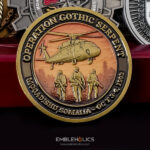
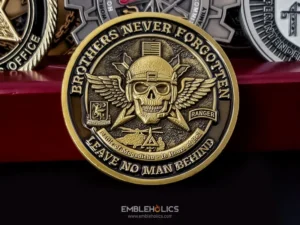
Embleholics created an Operation Gothic Serpent commemorative challenge coin designed around the history and symbolism of the mission.
The design features the date October 3, 1993, marking the beginning of the battle. It also incorporates two Black Hawk helicopters, referencing the aircraft that were shot down and the crash sites that became central to the extended firefight.
The reverse pays tribute to units connected to the operation, including Delta Force, Army Rangers, the Night Stalkers, and the 10th Mountain Division. A map of Somalia provides geographic context, while the phrase “Leave No Man Behind” reflects the commitment to recovering and protecting fellow service members during the battle.
The Army’s role in Operation Gothic Serpent also connects this project to a much broader tradition of Army challenge coins created around units, deployments, combat operations, retirements, awards, and military history.
Preserving Military History Through Challenge Coins
A commemorative coin can preserve details that matter to the people connected to an operation: dates, unit insignia, aircraft, vehicles, locations, maps, mottos, names, and other elements of a shared history.
Features such as dimensional artwork can be particularly useful for military designs involving aircraft, vehicles, equipment, terrain, or detailed insignia. Our challenge coin manufacturing options show different approaches to 2D and 3D artwork, metal finishes, custom shapes, edge details, color, and other design features.
You can also browse our challenge coin gallery to see completed military and organizational projects.
Create a Coin to Remember Your Unit or Mission
Operation Gothic Serpent demonstrates why military history is often intensely personal to the people who experienced it. A challenge coin can preserve that history in a form that can be carried, displayed, presented to fellow service members, or passed on to future generations.
If you’re creating a coin for a military unit, deployment, reunion, memorial, historic operation, or another meaningful event, request a free challenge coin quote and send us your concept, reference images, quantity, and project details.
Recent Posts