What Operation Eagle Claw Taught Us About Leadership and Resolve
In the early morning hours of April 24, 1980, the desert winds of Iran carried more than sand. They carried the hopes of a nation waiting to see whether America could bring its people home. Fifty-two hostages had been held in Tehran for over five months. The mission to rescue them—codenamed Operation Eagle Claw—would involve the most elite forces the United States could assemble. It would also become one of the most scrutinized failures in U.S. military history. Yet within its failure, a new chapter in American special operations was born.
From the ashes of tragedy and miscalculation emerged doctrine, leadership, and unity. Eagle Claw’s legacy lives not in the outcome, but in the transformation it inspired. In its story are lessons of resolve, humility, and the power of rebuilding stronger than before.
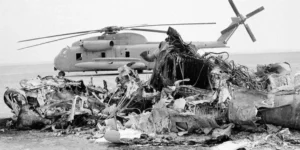
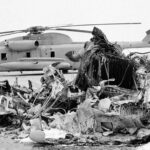
Wreckage at Desert One. The remains of a RH-53D helicopter after the tragic collision during Operation Eagle Claw, April 24, 1980.
A Mission Lost, a Doctrine Rewritten
The Iran Hostage Crisis began on November 4, 1979, when Iranian revolutionaries stormed the U.S. Embassy in Tehran. Amid political upheaval, they took 66 American hostages—50 of whom would remain captive for 444 days. President Jimmy Carter, facing mounting pressure at home, authorized a bold rescue mission led by the newly created 1st Special Forces Operational Detachment-Delta (Delta Force).

Storming the U.S. Embassy. Iranian students scale the walls of the U.S. Embassy in Tehran on November 4, 1979. This moment marked the beginning of the Iran Hostage Crisis, setting the stage for Operation Eagle Claw.
The mission plan was extraordinarily complex. It involved flying eight RH-53D Sea Stallion helicopters from the USS Nimitz and Coral Sea to a remote Iranian desert landing site known as Desert One, where they would rendezvous with C-130 aircraft carrying fuel and personnel. From there, the assault team would proceed by truck to hide near Tehran until the following night, when the actual embassy raid would occur.
Everything had to go perfectly. But…
It didn’t.
A series of mechanical failures and miscommunication unraveled the plan. Two helicopters turned back due to rotor blade and hydraulic issues. A third, upon landing at Desert One, was deemed inoperable. That left only five helicopters—one short of the minimum six needed for the mission.
Despite the disappointment, Carter made the responsible call to abort. But tragedy struck as the team attempted to withdraw. One of the RH-53Ds collided with a parked C-130 during refueling, causing a massive explosion. Eight American servicemen—five Air Force, three Marines—lost their lives.
Their sacrifice was not in vain. The failed mission exposed critical gaps in command, control, aviation coordination, and joint service operations. And in that failure, the seeds of transformation were sown.
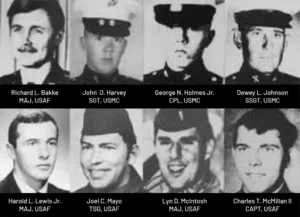
The eight servicemen who died included three Marines and five Air Force personnel. Above is Maj. Richard L. Bakke, Sgt. John D. Harvey, Cpl George N. Holmes, Jr., SSgt. Dewey L. Johnson, Maj. Harold L. Lewis Jr., Sgt. Joel C. Mayo, Lyn D. McIntosh, and Capt. Charles T. McMillan II. Courtesy of specialops.org.
Legacy in the Shadows: What We Still Carry from Desert One
In the military, failure can be a crucible. And Operation Eagle Claw, a textbook example of a failed U.S. military operation, proved to be just that.
Following the mission’s failure, a bipartisan commission was assembled to assess what went wrong. Its conclusions were blunt: lack of unified command, inadequate training, and no dedicated special operations aviation support. The different service branches hadn’t trained together. Their equipment wasn’t compatible. Their communications were fractured.
These weren’t minor issues. They were structural flaws in America’s ability to project elite military force globally. And so, the Pentagon responded with sweeping reform.
Delta Force Origins and the Rise of Special Operations
Operation Eagle Claw was the first true test for Delta Force, the brainchild of Colonel Charles Beckwith. Modeled after the British SAS, Delta was envisioned as a precision counterterror unit capable of executing complex hostage rescues and high-value raids. Eagle Claw would become their crucible.
Timeline of Transformation After Operation Eagle Claw
| Year | Milestone | Description |
| 1980 |
Operation Eagle Claw
|
A failed rescue mission in Iran that exposed critical gaps in U.S. special operations capabilities. |
| 1981-1986 |
Strategic Review Period
|
Military and congressional investigations identify lack of coordination, inter-service training, and support. |
| 1987 |
U.S. Special Operations Command (USSOCOM)
|
Created to unify command of all special operations forces and coordinate missions across military branches. |
| 1987 |
Joint Special Operations Command (JSOC)
|
Formed to enhance inter-agency cooperation and manage elite counter-terrorism operations. |
| Late 1980s | 160th Special Operations Aviation Regiment (Night Stalkers) | Established to provide elite aviation support, particularly for night-time and covert missions. |
| 1980s-1983 |
SEAL Team Six
|
Developed for maritime hostage rescue and counter-terrorism; formed in direct response to the operational gaps revealed in Eagle Claw.
|
The Quiet Leaders Who Emerged
Eagle Claw also tested leaders in the crucible of failure. One was then-Major Richard “Dick” Meadows, a Delta Force officer who played a key role in planning. Though the mission didn’t succeed, his calm resolve and insight helped shape future planning doctrines. Others, including Colonel James Kyle and Major John Carney, would go on to contribute heavily to joint operations doctrine.
These were not leaders celebrated with victory banners. They were men who led in the dark, who learned the hard way, and who ensured the next generation would not make the same mistakes.
Operation Eagle Claw represents more than a failed attempt for those who wear the uniform. It’s a solemn chapter etched into the doctrine and soul of the modern American warrior. The mission failed, yes. But it revealed an unforgiving truth: courage alone is not enough. Planning, coordination, and communication—these are what transform valor into victory.
The fallen were honored in a ceremony at Arlington National Cemetery. Their names etched into memorials. But the most enduring tribute may be the lives saved by the lessons they helped uncover. Every successful special operation since—from Panama to Pakistan—owes a debt to what was learned on that desert floor.
Today, when Delta Force or the SEALs execute a mission with surgical precision, they do so with ghosts at their side. The men of Desert One didn’t get to rescue the hostages. But they rescued the future of American special operations.
At Embleholics, we forge tangible reminders of history’s most defining moments. Operation Eagle Claw is a powerful example of why we do what we do.
Let us help you honor those who served in silence, those who rebuilt from failure, and those who carry that legacy into every mission today.
Recent Posts