In 1823, the United States made its position clear.
A formal message to Congress marked history as much as any battle. The message stated that the Western Hemisphere was no longer open to European colonization. Any attempt by outside powers to extend their political systems into the Americas would be viewed as a threat.
That statement became known as the Monroe Doctrine. More than 200 years later, its logic still shapes how the United States views influence in its own hemisphere.
Historical Context
The World That Shaped the Doctrine
To understand the Monroe Doctrine, you have to step into the early 19th century.
Spain’s empire was crumbling. Portugal’s hold on Brazil had weakened. Across Latin America, revolutions were breaking colonial rule and forming new nations. Fresh off the defeat of Napoleon, Europe’s monarchies were regrouping. There were real concerns that Spain might attempt to reclaim its former colonies with help from other European powers.
The United States was young, militarily limited, and economically developing. It did not yet have the strength to enforce a global position.
What it did have was geography working in its favor: oceans separated the Americas from Europe, and that distance provided natural security.
American leaders understood that allowing European powers to reestablish colonies in the Western Hemisphere would threaten that security, and the hard-won independence of newly formed nations across the Americas.
President James Monroe

Fifth U.S, President James Monroe
In his 1823 annual address, President James Monroe made the position clear:
- The Americas were closed to further European colonization.
- European political interference in the hemisphere would be considered dangerous to U.S. peace and safety.
- In return, the United States would stay out of European internal affairs and wars.
At the time, the doctrine was more principle than power. The United States did not yet have the influence to enforce it. At the same time, driven by its own trade interests, British naval power played a major role in deterring European action.
Although it lacked enforcement, Monroe’s statement established something lasting: the idea that the Western Hemisphere was strategically distinct.
A clear declaration of boundaries.
A Thicker Influence
Over the next century, the Monroe Doctrine evolved.
Initially, it served as a warning against renewed European colonization. But as the United States grew stronger economically, industrially, and militarily, its role expanded.
In 1904, the Roosevelt Corollary reframed it. The United States asserted the right to intervene in Latin American nations experiencing instability, particularly if that instability risked inviting European involvement.
President Theodore Roosevelt Jr.
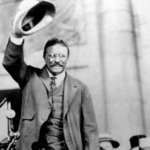
Theodore Roosevelt Jr., 26th president of the United States
The reasoning was straightforward: if outside powers might use debt disputes or unrest as an excuse to intervene, the United States would act first.
The doctrine shifted from “keep Europe out” to “we will manage instability here ourselves.” U.S. involvement followed in places like Cuba, Panama, Nicaragua, Haiti, and the Dominican Republic. Some actions were framed as stabilization efforts; others functioned as strategic assertions of power that left lasting resentment across Latin American nations.
The Western Hemisphere avoided large-scale European recolonization. But it also became, in practice, a sphere of dominant U.S. influence.
The line drawn in 1823 had grown thicker.
The Cold War Revival
Special Warfare Specialist Challenge Coin

Military coin commissioned by a former special warfare specialist who wanted to represent his company to customers. The back of the coin design features two crossed rifles with a beautiful waving American flag background, along with the Seal Trident in great detail and a fitting phrase around the edge.
Decades later, the Monroe Doctrine reemerged in the 20th century under far higher stakes.
In 1962, the Cuban Missile Crisis brought the world to the edge of nuclear confrontation. The placement of Soviet missiles in Cuba, just 90 miles from Florida, was considered intolerable.
The original 1823 language was not cited directly, but the underlying principle remained the same: rival great powers would not establish strategic military footholds in the Western Hemisphere.
The Cuban Missile Crisis reflected a broader pattern. Throughout the Cold War, the United States worked to limit Soviet influence across the region, supporting governments, intervening in conflicts, and shaping political outcomes to prevent the establishment of rival footholds close to home.
During the Cold War, that logic shaped policy across Latin America and the Caribbean. The doctrine evolved from European monarchies to superpower competition.
What the Doctrine Left Behind
What It Meant for the Western Hemisphere
The Monroe Doctrine left a complex legacy.
It contributed to a hemisphere largely free from formal European recolonization. Compared to Europe’s long history of great-power wars, the Americas avoided repeated continental conflict driven by outside empires.
At the same time, the doctrine’s expansion blurred the line between protection and intervention. In parts of Latin America, U.S. actions were viewed less as guardianship and more as dominance. Sovereignty became a central concern.
The doctrine protected the hemisphere from external control. It also raised lasting questions about influence, autonomy, and power.

Why It Still Matters Today
The strategic logic behind the 1823 Monroe Doctrine remains relevant.
Today’s competition centers on infrastructure, ports, digital networks, rare earth minerals, energy corridors, and military partnerships. When outside powers expand their presence in Latin America, whether economically or militarily, it draws attention in Washington.
Why?
Because geography has not changed.
Trade routes, migration flows, supply chains, and security concerns bind the hemisphere together. What happens next door carries a different weight than what happens across an ocean.
The modern debate has shifted from colonization to influence within a multipolar world.
How much external involvement is acceptable in the Western Hemisphere? When does economic engagement become strategic leverage? Where is the line between partnership and power projection?
Those questions echo the same instinct first articulated in 1823, an instinct that has since shaped stronger policies and ongoing debates over sovereignty.
SpaceX Starlink Challenge Coin

The SpaceX Starlink Challenge Coin centers on the Western Hemisphere—highlighting the Americas and the growing reality of a more connected continent.
Security, Influence, and Autonomy
Nearly every major power in history has sought stability in its immediate region. Proximity magnifies risk. The closer a rival power is to critical infrastructure, major population centers, or trade routes, the greater the perceived threat.
At the same time, nations across the Americas pursue growth, investment, and diversified partnerships. They are sovereign actors navigating global economic and strategic opportunities.
Balancing regional security concerns with national autonomy remains one of the defining challenges of the Western Hemisphere.
The Monroe Doctrine does not provide easy answers. It does explain the framework. And that framework continues to shape how those tensions are managed today.
Featured read: Operation Absolute Resolve: How U.S. Forces Captured Nicolás Maduro — A Strategic and Tactical Analysis
The Enduring Line — Moments that Deserve to be Remembered
Two centuries later, the Monroe Doctrine functions more as a strategic reflex. When outside powers attempt to establish a significant military or strategic presence in the hemisphere, the United States responds, sometimes diplomatically, sometimes economically, and at times more forcefully.
The wording may evolve. The rivals may change. The tools may modernize.
The doctrine remains.
As global power dynamics shift once again, the Western Hemisphere may return to center stage. The question is how the Monroe Doctrine will continue to be interpreted in the decades ahead.
History shows that lines drawn in defense of sovereignty shape generations.
When history matters, when legacy, service, and defining moments deserve to be remembered, symbols matter too. If your organization, unit, or team is commemorating a milestone rooted in American history, leadership, or strategic resolve, a custom challenge coin becomes a statement of that moment.
At Embleholics, we turn moments like these into lasting pieces of craftsmanship that honor heritage and stand the test of time.
Recent Posts