
If you’ve got a challenge coin in your pocket, you’re aware of what it represents. Bravery, a deployment, service, even sacrifice. You might be a veteran, a firefighter, a law enforcement officer— even a Mason.
But have you ever wondered where the challenge coin custom started? In this article, we’ll explore the various historical accounts of challenge coins dating back to the Roman Empire and World War I.
Strap in as we inform you all about challenge coin history and where trends are moving in the future.
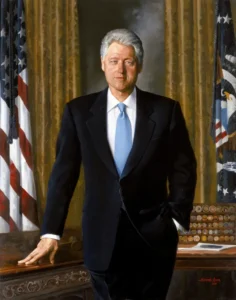
Challenge coins displayed behind former President Bill Clinton.
The Ancient History of the Challenge Coin
The origin of challenge coins begins as far back as the Roman Empire. Although they weren’t called “challenge coins” at the time, they served a similar purpose.
According to historians, Roman soldiers would receive a bonus coin along with their daily pay if they excelled in battle. Since these coins were specially marked, soldiers often kept them as mementos rather than spending them.
Later, during the Renaissance, early variations of challenge coins were struck or minted, called “portrait medals.” They were typically given as awards or gifts to nobility, royalty, and well-off people. Usually, one side of the coin would feature the recipient’s portrait, while the other bore an image of their lineage, house, or family crest.
These commemorative portrait medals memorialized many important figures from the Renaissance and were able to communicate a lot of information about the recipient — either explicitly or through allegory and visual metaphor.
An Italian painter, Pisanello, first made portrait coins in honor of the Byzantine Emperor John VIII Paleologus’s visit to the Roman Catholic Church — a 10 inch medallion with the emperor’s portrait on one side, and a narrative scene on the reverse side.
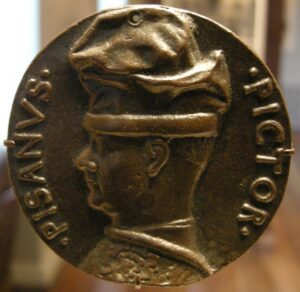
Antonio Marescotti Medaglia con Pisanello.
Over the course of the next 10 years, Pisanello made 26 various commemorative portrait coins. The first instance of using these coins in response to an actual challenge dates back to 17th-century France. During that time, many French Protestants fled the country to escape religious prosecution.
Those who remained formed a new group called the Huguenots. To avoid prosecution, they were forced to hold services in secret. To avoid infiltration from government spies, they created a special communion coin. Members of the church had to show this coin to be allowed entry into services.
History of Military Challenge Coins
Challenge coin history didn’t end with the Huguenots, as the legacy of the challenge coin tradition reinvented in the modern military. It’s not clear when the tradition of military challenge coins started. There are no written, verifiable records, but there are anecdotal accounts of where modern challenge coins originated.
The most common story goes like this:
During World War I, a wealthy lieutenant ordered several bronze coins to be made. He handed out these coins to members of his squad and kept his own coin tethered safely around his neck.
One fateful day, his plane was shot down behind enemy lines in Germany, and the lieutenant found himself surrounded by German soldiers. They stripped the man of all his possessions, save for one: the bronze coin.
Recent Posts