“Uncommon valor was a common virtue.” – Admiral Chester W. Nimitz
By mid–1945, the war in Europe had ended both on paper and on the battlefield. Yet that finality had not reached the Pacific. There, Japanese forces fought with a ferocity unmatched, willing to sacrifice their own lives to defend their homeland and avoid the dishonor of defeat.
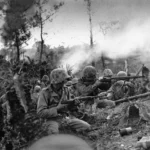
The Battle of Okinawa, one of Japan’s last strongholds, became the bloodiest campaign of the Pacific War, a storm of steel and fire that tested the courage of every man who fought there. From April 1 to June 22, 1945, more than 1.8 million soldiers, sailors, Marines, and airmen were drawn into the struggle. The island became a crucible where valor, sacrifice, and leadership were measured at their highest cost.
Okinawa is remembered as a chapter of history where Americans—ordinary young men who had left farms, factories, and cities—proved themselves in extraordinary ways. They advanced through caves and ridges under relentless fire, faced waves of kamikaze strikes at sea, and endured conditions that would have broken lesser armies. Yet they held the line. They carried each other forward. They made victory possible.
The meaning of that endurance still echoes today. For veterans, leaders, and all who honor their service, Okinawa is more than a battle. It is a reminder of the strength of American units, of commanders making impossible choices under fire, and of the unyielding spirit of a generation that refused to surrender. Their courage is not distant history, it is a standard that still calls to us.
America’s Hardest-Fought Victory in the Pacific
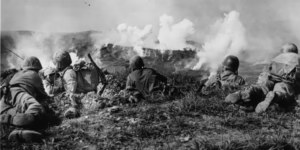
From the first landings in April until the last shots in June, Okinawa became the longest and most punishing struggle of the Pacific War. For eighty-two days, American forces fought ridge by ridge and cave by cave against an enemy that refused to yield. The island itself turned into a crucible where endurance was measured not in hours or days, but in relentless weeks of combat.
Victory, though never in doubt, came at a staggering price. More than 12,000 Americans gave their lives, each number a name and each casualty a story cut short. The U.S. Navy endured over 1,500 kamikaze attacks, turning the seas into battlefields where sailors fought not only to survive but to keep the fleet in the fight. On land, Marines and soldiers pressed forward under constant fire, carrying with them the determination of a nation that would not retreat.
Reports preserved by the National WWII Museum describe Okinawa as the deadliest campaign in the Pacific, where the island itself seemed determined to resist. That assessment is echoed by the stories of Marines who advanced through hills with names like Sugar Loaf and Half Moon, places where entire companies were cut down before they reached the crest.
It was this relentless push, carried by ordinary Americans proving themselves extraordinary, that forged the final link in the chain bringing Japan to its knees. Yet the scale of the battle is only part of its legacy, for the battle of Okinawa was not just a victory earned through strategy and firepower, but through the unyielding resolve of those who refused to stop until the mission was complete.
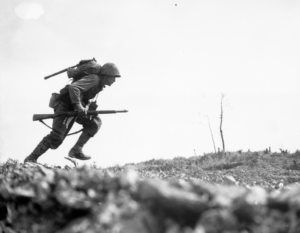
A Marine dashes through Japanese machine gun fire while crossing a draw, called Death Valley by the men fighting there. Okinawa. May 10, 1945. National Archives.
The Island That Became a Storm of Steel
Why was this the bloodiest chapter of the Pacific War? The answer lies in the nature of the island itself. Okinawa had been transformed into a fortress, its ridges carved with tunnels and caves, its villages turned into defensive strongholds. Every American advance was met with ambush, hidden fire, and counterattack, turning progress into a slow and costly march.
At sea, kamikaze pilots hurled themselves against the fleet in waves larger than any the war had seen, sending ships to the bottom and turning decks into fields of fire. These attacks were organized in massive waves known as Kikusui, a tactic designed to cripple the Fifth Fleet and halt the invasion. On the ground, Marines and soldiers pushed forward yard by yard, fighting not only entrenched defenders but also terrain that seemed to conspire against them.
The tragedy reached far beyond the battlefield. Tens of thousands of civilians were caught in the crossfire, their lives torn apart in a storm they did not choose. Historians from the U.S. Army Center of Military History record that between 100,000 and 150,000 Okinawan civilians perished during the campaign. Entire families were driven into caves, pressed into labor, or consumed by bombardments. The combination of desperate defense, merciless sacrifice, and unbearable civilian suffering is what earned Okinawa its place as the most brutal and costly struggle of the Pacific.
When Command Meant Carrying the Heaviest Burden
In such a battle, leadership was not measured by rank alone, but by the weight of responsibility. American commanders faced an enemy that refused to surrender, a battlefield that swallowed men whole, and a fleet hammered day after day by kamikazes. Every decision carried lives in its balance, demanding both resolve and sacrifice.
General Simon Bolivar Buckner Jr., leading the Tenth Army, pressed his men forward through weeks of brutal resistance. He walked the same ground they did, exposed to the same dangers. On June 18, 1945, he was struck and killed by enemy fire, the highest-ranking American officer lost in the Pacific War. His death proved that command was not a shield from danger, but a burden carried alongside those you lead.
At sea, admirals and captains bore the responsibility of holding the line as more than 1,500 kamikazes turned the skies into weapons. Damage control teams battled flames while officers kept ships in formation, refusing to let the fleet break apart.
Even the enemy bore its own grim weight of command. General Mitsuru Ushijima refused to surrender, ordering his men to fight until annihilation before taking his own life by ritual suicide. His decision condemned thousands but reflected a culture where command was defined by sacrifice to the very last breath.
Leadership in the battle of Okinawa is not simply issuing orders, but carrying the heaviest burden, standing firm when others look to you for strength, and accepting the cost when victory demands everything.
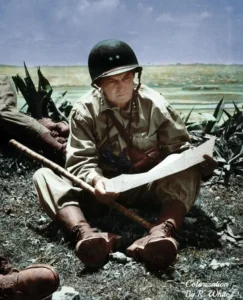
Major General Simon Bolivar Buckner Jr. on Okinawa, Summer, 1945.
The Guidance Passed From One Generation to the Next
When the guns finally fell silent in June 1945, the lessons of the battle of Okinawa did not fade with the smoke. They were carried home by veterans, etched into the doctrine of every service branch, and passed down to the leaders who followed.
- The first of those lessons is endurance. Victory is rarely swift, and warriors must be ready not just for the first strike, but for the long and punishing fight that follows. Okinawa proved that triumph belongs to those who refuse to bend, even under fire that never seems to end.
- The second is responsibility. The suffering of civilians on that island remains a solemn reminder that command is never limited to tactics and terrain. True American leadership weighs the human cost, knowing that duty extends to protecting lives as well as securing objectives.
- The third is will. Technology and firepower can turn the tide, but they cannot replace the resolve of the human spirit. Kamikazes, fortified ridges, endless artillery—all pressed American forces to the brink, yet they endured with discipline, unity, and sheer determination.
Together, endurance, responsibility, and will form a standard that has outlasted the war itself. From the veterans who carried those lessons home to the commanders of today who lead in their shadow, the battle of Okinawa remains more than history. It is a torch of American grit passed from one generation to the next.
Commander’s Call. Honoring the Legacy
Okinawa was won at a cost measured in blood and sacrifice. More than two hundred thousand lives were lost in that storm, and with them came lessons no leader or warrior can afford to ignore.
For veterans, the memory of Okinawa is not distant, it is a living reminder of what their brothers endured, of the grit and resolve that define the American fighting spirit. For leaders, it stands as proof that discipline, resilience, and courage are the true instruments of victory.
We honor those who fought not only with words but with symbols that endure. A challenge coin passed from hand to hand carries the same message that Okinawa still whispers to every generation: courage remembered, sacrifice never forgotten, leadership proven in the crucible of war.
If your unit’s story deserves to be remembered, contact us today to create a custom challenge coin that carries your legacy forward with honor.
Until Next Mission.
Recent Posts