Veteran challenge coins are small enough to slip into a pocket and easy to overlook at first glance. Over time, though, they tend to take on meaning far beyond their size. Worn edges, scratched surfaces, and weight from daily carry often reflect something deeper: service, shared experience, and a connection to a time in life that still matters.
For many veterans and service members, challenge coins also serve a quieter purpose. They can act as a reminder of identity, continuity, and belonging—especially during periods when connection feels harder to maintain. While they are not a solution to mental health challenges, veteran challenge coins can play a role in supporting conversations that might otherwise never begin.
Veteran Mental Health Goes Beyond Combat PTSD
Public discussions about veteran mental health often focus on combat-related post-traumatic stress. While combat stress is real and serious, it represents only part of the broader mental health landscape for veterans. Many individuals who served—whether they deployed or not—experience challenges that stem from transition, identity change, and loss of structure rather than a single traumatic event.
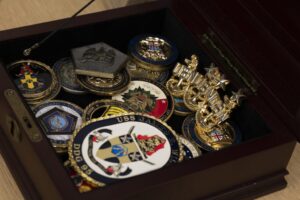
TAMPA, Fla. (July 24, 2025) A collection of challenge coins is displayed on a desk inside Navy Recruiting Station Tampa, an office under Navy Talent Acquisition Group (NTAG) Miami.. NTAG Miami has 38 recruiting locations throughout South Florida, Puerto Rico and the Virgin Islands, with the combined mission to recruit the highest caliber Sailors to meet the needs of the fleet. (U.S. Navy photo by Mass Communication Specialist 1st Class Natalia Murillo).
Leaving military service often means losing daily routines, a clear mission, and a built-in support network all at once. According to the U.S. Department of Veterans Affairs, a significant portion of veterans receiving care are diagnosed with mental health conditions, while many others struggle without formal diagnosis or treatment. Common challenges include anxiety, depression, substance use, and persistent feelings of isolation. These experiences cut across branches, roles, and service histories.
Why Tangible Symbols Still Matter After Service
The military has always relied on tangible symbols to reinforce identity and belonging. Uniforms, patches, rank insignia, and awards make service visible and shared. Challenge coins fit squarely within that tradition, but they differ in one important way: they are personal without being performative.
Veteran challenge coins are often carried privately rather than displayed publicly. That makes them especially powerful during transition periods, when outward markers of service may fade but internal identity remains strong. A physical object tied to service can help reinforce continuity between past and present, reminding the holder that their experiences still count—even when civilian life feels disconnected from military structure.
From Military Tradition to Modern Connection Tool
Historically, military challenge coins have been used to recognize achievement, membership, and shared mission. That tradition remains intact today, but many organizations have expanded how they use coins. Veteran challenge coins are increasingly designed with connection and community in mind, not just recognition.
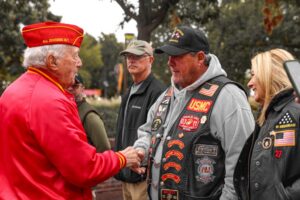
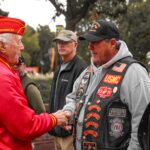
Mr. Don Campanile, left, a member with the Marine Corps League and Pennsylvania native, gives a challenge coin to Mr. Thomas Walsh, right, a Beirut veteran, and a Pennsylvania native during a Beirut memorial wreath laying ceremony as part of Navy Marine Corps 250 in Philadelphia, Pennsylvania Oct. 11, 2025. NMC 250 honors 250 years of Navy and Marine Corps legacy, tradition, and service by giving Philadelphia residents and visitors the opportunity to connect with Marines and Sailors, learn about the Corps’ values of honor, courage, and commitment, and experience community engagement events, static displays and performances from the Special Purpose Marine Air-Ground Task Force 250. (U.S. Marine Corps photo by Lance Cpl. Dominic Trujillo).
In this context, the coin becomes a subtle social tool. It provides a shared reference point that can make interaction easier, especially among veterans who may be reluctant to initiate deeper conversations. The presence of a coin can signal belonging, mutual understanding, and openness without requiring explanation or disclosure.
Veteran Challenge Coins as Conversation Starters
Starting conversations about mental health can feel awkward or unnecessary until stress becomes overwhelming. Veteran challenge coins can help lower that barrier by creating natural moments of recognition and engagement. A coin noticed, shared, or acknowledged can open the door to a simple check-in that might otherwise feel forced.
Because challenge coins are rooted in shared experience, they reduce the need for context. They allow connection to begin from a place of mutual understanding rather than explanation. In many cases, that small shift is enough to make conversation feel acceptable and appropriate.
A Tool for Awareness, Not a Substitute for Care
It’s important to be clear about what veteran challenge coins are—and what they are not. They are not therapy, treatment, or a replacement for professional mental health care. They do not diagnose problems or solve them.
What they can do is support awareness and continuity. A challenge coin can serve as a quiet reminder that support exists and that reaching out is normal. For some veterans, that reminder matters most during everyday moments, not crisis points.
For those who do want or need immediate support, resources are available. In the United States, the 988 Suicide & Crisis Lifeline offers 24/7 support, and veterans can press 1 to connect with responders trained to work with the veteran community. This service is available whether someone is in crisis or simply wants to talk.
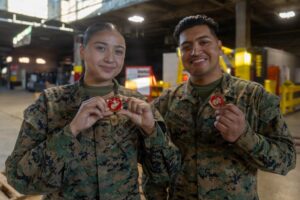
U.S. Marine Corps Lance Cpl. Cina Reyes, left, an inventory management specialist, and Lance Cpl. Jorge Martinez, a supply chain specialist, both with 2nd Combat Readiness Regiment, 2nd Marine Logistics Group, pose for a photo after receiving challenge coins from U.S. Marine Corps Brig. Gen. Joel Schmidt, assistant division commander, 2d Marine Division, at Marine Corps Base Camp Lejeune, North Carolina, Nov. 4, 2025. The assistant division commander visited 2nd CRR Marines to learn how they provide higher levels of supply management and maintenance to II Marine Expeditionary Force in garrison and while forward deployed. (U.S. Marine Corps photo by Lance Cpl. Javier Santillan).
Designing Veteran Challenge Coins With Mental Health in Mind
Thoughtful design plays a significant role in how a challenge coin is used and perceived. When veteran challenge coins are intended to support connection and mental health awareness, design choices should reinforce that purpose without being heavy-handed.
Many effective designs balance identity and support. One side may feature branch, unit, or organizational insignia, grounding the coin in service and tradition. The reverse side can include a subtle phrase, symbol, or reminder that points toward connection or resilience.
Language matters. Short, understated phrases often work best because they invite reflection rather than instruction. Durability also matters—coins designed for everyday carry are more likely to remain part of a veteran’s routine rather than becoming a display item.
Some organizations choose to include discreet resource information, such as a small line referencing available support. When done thoughtfully, this communicates care and preparedness without implying that the holder is struggling.
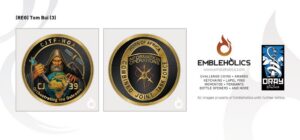
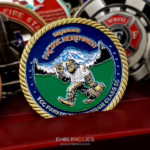
CJTF-HOA Information Operations Challenge Coin Artwork.
Where Veteran Challenge Coins Are Most Effective
Veteran challenge coins have the greatest impact when they are tied to real communities and ongoing interaction. They are especially effective in environments where connection already exists or is being intentionally built.
Common use cases include:
- Veteran peer groups and meetups
- Nonprofit programs and mentorship initiatives
- Military and veteran employee resource groups
- Transition programs, reunions, and milestone events
Coins tend to carry more meaning when they are earned, shared intentionally, or connected to participation rather than distributed casually. Context gives the coin its purpose.
A Small Object That Supports Staying Connected
Veteran mental health challenges are complex and personal. There is no single cause and no universal solution. However, connection—to people, purpose, and shared experience—consistently plays a role in long-term well-being.
Veteran challenge coins do not solve these challenges, but they can support the moments that matter. They can make reaching out feel more natural, reinforce identity during transition, and remind veterans that they are part of something larger than themselves. Embleholics is proudly veteran-owned and we pride oursleves on our craftsmanship. Reach out if you’re interested in designing your own challenge coin.
Sometimes, a simple token is enough to keep the conversation open.
Recent Posts