
From the thundering cannons of Yorktown to the precision strikes of modern wars, U.S. artillery has always been more than a weapon, it’s the backbone of victory. Every generation of American artillerymen has carried the same belief carved into their creed: “King of Battle.”
When George Washington’s Continental Army fought for independence, artillery commander Henry Knox moved sixty tons of cannons through ice and wilderness to siege Boston — a feat of resolve that defined American grit. In the Civil War, the Union’s use of rifled cannons and massed fire changed how wars were fought, proving that industrial power could decide the fate of nations.

From bronze cannons to GPS-guided rounds, American artillery has carried the same purpose: to defend freedom with strength and skill.
By the time the United States entered the World Wars, its artillery doctrine had become a science. In the trenches of France, American gunners mastered the mathematics of death, time-on-target barrages that crushed German lines. In World War II, the synergy of mobility and precision turned artillery into a storm of steel across two hemispheres. In Korea and Vietnam, self-propelled howitzers and air-delivered ordnance extended the reach of the battlefield.
From Desert Storm to the Mountains of Afghanistan
The end of the Cold War didn’t end America’s reliance on artillery, it redefined it. During Desert Storm, the M109 Paladin and Multiple Launch Rocket System (MLRS) proved that range and accuracy could devastate armored divisions before they even saw the enemy. A decade later, in Afghanistan, U.S. artillery became the guardian angel of troops in hostile terrain.
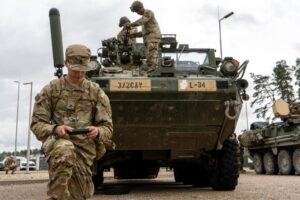
Modern U.S. artillery crews combine mobility, data, and precision — the soldier and the machine moving as one.
In Helmand and Kunar, gun crews learned to trade saturation fire for surgical precision. GPS-guided Excalibur rounds struck within meters of the target, often in support of small units under fire. For soldiers on the ground, the thunder that followed the call “fire mission!” wasn’t just sound, it was survival.
Across generations, the tools have changed, but the principle remains the same: American artillery doesn’t follow the fight; it defines it.
The Long March from Smoke to Precision
Artillery tells the story of American innovation. Each leap in range and accuracy mirrors the nation’s drive to outthink, outbuild, and outfight any adversary.
In World War I, gunners hauled 155-millimeter howitzers through the mud. In World War II, Sherman tanks and mobile guns turned firepower into a moving wall. The Cold War introduced atomic artillery, a terrifying reminder that American science could match its courage.
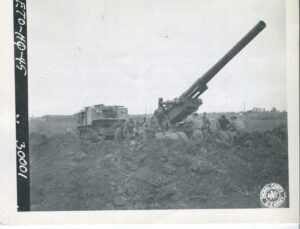
American artillerymen in World War II — the original masters of coordination, courage, and calculated power.
Then came the revolution: computers, satellites, and data. The MLRS and later the HIMARS systems gave commanders precision that once belonged only to fantasy. The click of a tablet now replaces the slide rule; the fire mission travels by encrypted signal rather than shouted coordinates.
Lessons from Iraq and Afghanistan accelerated this evolution. Satellite-guided targeting, real-time drone surveillance, and instant data sharing between units transformed fire missions into immediate, devastating responses. Artillery that once required minutes to adjust now answers in seconds.
Today, a U.S. battery can rain steel on an enemy position from more than forty miles away, all while moving to avoid counterfire. The term “mobile firepower” no longer means trucks and tubes, it means intelligence, precision, and control.
“Firepower wins wars.” — General Curtis E. LeMay, U.S. Air Force

The M109 Paladin — America’s enduring symbol of mobile firepower and precision on the modern battlefield.
The Hands That Command the Horizon
No military on Earth integrates firepower like the United States. Across land, sea, and sky, the coordination of artillery assets forms a single, unstoppable orchestra of destruction.
On land, the U.S. Army’s HIMARS has rewritten the rules of engagement. Deployed from mobile launchers, its rockets can destroy targets seventy kilometers away with pinpoint accuracy. The Paladin M109A7 howitzer — faster, smarter, deadlier — represents six decades of continuous refinement. The Excalibur round, guided by GPS, turns a 155-millimeter shell into a sniper’s bullet.
At sea, the U.S. Navy maintains the world’s most sophisticated naval artillery. From 5-inch guns that support Marines ashore to Tomahawk cruise missiles capable of striking inland targets hundreds of miles away, American warships extend the nation’s reach beyond the horizon. Experiments with electromagnetic railguns and hyper-velocity projectiles promise to take this dominance even further.
In the air, the legacy continues. Bombers like the B-52 and B-1 carry payloads once unimaginable, delivering “artillery by altitude.” Drones and stealth aircraft now coordinate directly with ground fire controllers, merging the artilleryman’s discipline with the pilot’s precision.
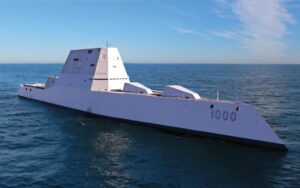
From sea to shore, naval artillery like the USS Zumwalt extends U.S. dominance across every horizon.
Eyes in the Sky. Drones and the New Age of Targeting
The rise of unmanned systems has transformed how artillery sees the battlefield. Drones now hover silently over enemy positions, relaying real-time data to fire control centers. They don’t replace the gun line, they sharpen it. Instead of guessing at coordinates, American crews fire with the precision of soldiers who can see through clouds, smoke, and distance.
From small quadcopters spotting targets to high-altitude reconnaissance feeding live coordinates into HIMARS systems, drones have turned artillery into a networked weapon, faster, smarter, and deadlier than ever.
The artilleryman’s eyes are no longer fixed to the horizon; they soar above it.
This integration — land, sea, air, and cyber — is what sets the United States apart. While other nations struggle to coordinate branches, America’s doctrine fuses them. The result is overwhelming synergy: instantaneous communication, shared targeting, and a tempo of fire that no adversary can match.

Artillery by altitude — American airpower during Desert Storm turned the sky itself into a battlefield of precision and dominance.
Firepower That Protects, Not Provokes
Artillery has never been only about destruction. It’s about deterrence, the promise that strength prevents conflict. “Peace through superior firepower” isn’t just a motto; it’s a cornerstone of U.S. strategy.
The silhouette of a howitzer against a sunset, the red cord on a uniform, the crossed-cannons insignia, these symbols speak to something deeper: mastery, discipline, and precision. Within the ranks, artillerymen carry a unique pride. They are the unseen guardians, the ones who deliver decisive force when diplomacy ends.
For those who served in the wars of the 21st century, the thunder of outgoing rounds in Afghanistan isn’t only memory, it’s meaning. It represents teamwork under pressure, sleepless nights on gun lines, and the knowledge that their accuracy protected brothers and sisters in arms. That shared legacy — from Normandy to Kandahar — binds generations together in red and gold.
Globally, American artillery embodies credibility. Adversaries may test the edges, but they know the cost of miscalculation. Each advancement, from guided munitions to hypersonic systems, reinforces a simple truth: when the United States fires, it does so with purpose, precision, and absolute superiority.
Where Strength and Freedom Speak the Same Language
For nearly 250 years, artillery has been the heartbeat of American strength. It has spoken in thunder at moments when freedom hung in the balance — from the walls of Yorktown to the valleys of Afghanistan.
Technology will continue to evolve. Artificial intelligence will guide new weapons; hypersonic missiles will stretch range beyond imagination. But the spirit that drives American artillery — discipline, innovation, and the will to win — will never change.
“The artillery conquers, the infantry occupies.” — Napoleon Bonaparte
Two centuries later, the United States perfected that truth — transforming firepower into precision, and conquest into protection.
Artillery remains the thunder behind the flag — a promise that wherever freedom stands, the United States will defend it with unmatched precision and power.
At Embleholics, we honor the men and women who keep that thunder alive. Every coin we craft is forged in the spirit of American excellence — precision, courage, and craftsmanship that reflect the same values driving the world’s greatest military. From the first cannon at Yorktown to the cutting-edge systems of today, U.S. artillery stands as proof that freedom endures when strength stands ready. Our challenge coins carry that legacy forward, each one a symbol of pride in the nation that leads, protects, and inspires the free world.
Because when America defends, it doesn’t follow — it leads. And when we design, we honor that same unstoppable spirit.
Recent Posts