What the Battle of Saipan Meant for Victory in the Pacific
The Battle of Saipan, fought from June 15 to July 9, 1944, was a monumental and bloody turning point in the Pacific Theater of World War II. Known as Operation Forager, this amphibious assault marked the first time U.S. forces directly attacked a large, heavily fortified island in the Central Pacific. The victory at the Battle of Saipan didn’t just change the battlefield—it reshaped the geopolitical trajectory of the war.
Commanded by Vice Admiral Richmond K. Turner (Task Force 52) and Lt. Gen. Holland M. Smith (V Amphibious Corps), the American offensive faced ferocious resistance from an entrenched Japanese garrison twice the estimated size. The stakes were high: capturing Saipan meant placing U.S. B-29 bombers within striking distance of Tokyo.
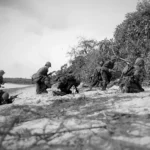
Saipan Operation, June-July 1944 Japanese Snipers hit two Marines (center and left) as a landing party storms ashore during the final stages of the conquest of Saipan. Photo Taken by a U.S. Coast Guard Photographer.
What Happened at the Battle of Saipan?
American forces began with intense aerial and naval bombardment, yet the Japanese defenders had prepared underground bunkers, fortified positions, and sniper nests hidden in Saipan’s rugged terrain. Initial intelligence underestimated the garrison’s strength (over 32,000 Japanese troops). Despite the onslaught, the defenders made the Marines fight inch by inch.
On D-Day, June 15, U.S. Marines landed under heavy fire. Amphibious tractors struggled through the reefs, and shore batteries damaged ships like the USS Tennessee. Snipers and artillery slowed the landings. By sunset, over 20,000 troops were ashore, with significant casualties.
The battle raged through Death Valley, Purple Heart Ridge, and up to Mount Tapotchau, Saipan’s highest point. Japanese forces launched counterattacks by night and dug into natural terrain, resisting every advance.
Why was it pivotal for the war?
| Feature | United States Forces | Japanese Forces |
| Command | Vice Adm. Richmond K. Turner, Lt. Gen. Holland M. Smith | Lt. Gen. Yoshitsugu Saitō, Vice Adm. Chuichi Nagumo |
| Troop Strength | ~71,000 (2nd & 4th Marine Divisions, 27th Infantry Division) | ~32,000 soldiers, including Imperial Navy personnel |
| Strategy | Amphibious assault, carrier air support, joint Army-Marine coordination | Static defense, cave warfare, last-resort banzai charges |
| Terrain Use | Coordinated multi-front beach landings and armored support | Mountains, sugar fields, cave systems, sniper nests |
| Outcome | Victory and airfield capture, strategic bombing staging ground established | Total garrison destroyed, mass suicides among troops & civilians |
With Saipan captured, the U.S. could now launch bombing raids on the Japanese mainland from newly established airfields. This directly led to the bombing campaigns over Tokyo and ultimately Hiroshima and Nagasaki. Japan’s military leadership was rocked: Prime Minister Hideki Tojo resigned shortly after the island fell. The battle also coincided with and influenced the decisive U.S. victory in the Battle of the Philippine Sea, crippling Japan’s carrier-based air power.
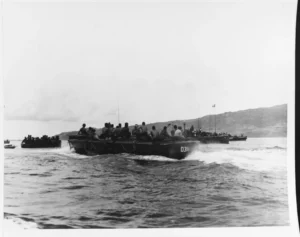
Underwater demolition team members en route to their working area, during the Saipan landings. They are in a LCP(R) from USS CLEMSON (APD-31). Photographed by Commander Bonnie Powell.
Inch-by-Inch Warfare in the Pacific
The U.S. suffered over 16,000 casualties, with ~3,000 dead. Japanese military losses were catastrophic: more than 24,000 killed and fewer than 1,000 captured.
But the most heartbreaking toll was among civilians. With over 26,000 Japanese civilians on the island, only about 18,000 were interned safely. An estimated 8,000 civilians died, many by suicide after being misled to fear capture. At Marpi Point (Banzai Cliff), entire families jumped to their deaths. American troops tried desperately to stop the mass suicides, calling out in Japanese, but were too late for many.
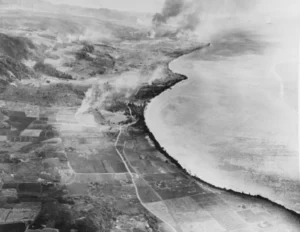
Saipan, June 1944: Naval bombardment in support of U.S. Marine Corps ground operations. Note the extensive cultivated areas (80-G-238385).
Leading Through Chaos in the Saipan Campaign
Saipan showcased both the horrors of war and the burden of leadership. Lt. Gen. Holland M. Smith had to coordinate Army and Marine units under fire, despite clashing doctrines and poor interservice communication. Commanders like Adm. Spruance had to anticipate naval threats from the Japanese fleet, which appeared in force and triggered the Battle of the Philippine Sea.
The psychological toll on leaders and soldiers alike was immense. Suicide, both ordered and voluntary, became a weapon and a tragedy. The Americans had to manage chaos, ethics, civilians, and global consequences—all in one island.
The Battle Remembered in Film
The battle’s legacy is echoed in the 2022 film The Battle of Saipan, starring Casper Van Dien. Set in the final days of the fight, it portrays a group of soldiers trapped in a hospital bunker as a banzai charge erupts above. Though dramatized, the film offers modern viewers a glimpse into the pressure, violence, and valor that defined the campaign.
While the film focuses on a small group of individuals, the broader reality was even more staggering. Over 3,000 American troops died, and more than 8,000 civilians—many of them families—perished amid shellfire, suicide, or starvation. Japanese commanders, unwilling to surrender, died by their own hand, while the U.S. quickly transformed Saipan into a launchpad for strategic bombing raids over Japan. The victory unraveled Japan’s military posture in the Central Pacific and forced a recalibration of its defensive doctrine.
Today, the cliffs of Saipan are a place of remembrance. For those who survived, and for generations that followed, Saipan stands as a symbol of ultimate sacrifice and strategic consequence. The island’s soil holds the weight of history—stories of command under pressure, impossible choices, and the quiet strength of those who endured.
At Embleholics, we believe history lives in every detail. Just like the heroes of Saipan, every custom coin we create honors sacrifice, resolve, and legacy. Let their story live on—etched in metal, and remembered forever.
Get a Free Quote Now!
Recent Posts