Bravery and Brotherhood
It´s impossible to forget the silence before a fight. For many Marines, that eerie stillness in the streets of Fallujah—just before the first breach—would mark the beginning of the fiercest urban combat since Vietnam. There were no grand speeches, no headlines, just boots hitting dirt and breath held tight.
The Second Battle of Fallujah, or Operation Phantom Fury, as it was also known, wasn’t just about reclaiming a city. It was about protecting brothers, proving resolve, and surviving a hell that tested every inch of who you were. Marines, soldiers, and Navy corpsmen didn’t just fight—they carried each other through concrete mazes laced with fire and shadows. In that crucible, some found purpose, others found pain. But all of them found each other. This wasn’t just war. It was a moment that carved itself into the legacy of the United States Marine Corps.
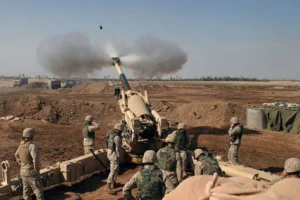
U.S. Marines from Mike Battery, 4th Battalion, 14th Marines, firing an M198 howitzer from Camp Fallujah.
Why the Second Battle of Fallujah Was Inevitable
By late 2004, Fallujah had become the most fortified insurgent stronghold in Iraq. After a failed attempt to retake the city in April (the First Battle of Fallujah), extremists—including foreign fighters, Al-Qaeda operatives, and local insurgents—tightened their grip. The city became a symbol of resistance, a propaganda tool for jihadists, and a growing threat to the stability of Iraq.
The tipping point came in March 2004 with the brutal killing and public mutilation of four American contractors. Their bodies were hung from a bridge in Fallujah—a message of defiance. In response, the U.S. military regrouped, refined its strategy, and prepared for a full-scale urban offensive.
The second battle of Fallujah was launched to dismantle this insurgent stronghold and restore control. The objective wasn’t only tactical; it was symbolic. No city could become a sanctuary for those who killed Americans with impunity. The message was clear: order would be restored.
Let´s Deep Inside the Battle, Timeline, Tactics, and Casualties
The Second Battle of Fallujah began on November 7, 2004, and lasted until December 23, 2004—47 days of grueling, high-intensity urban combat, making it, as many still ask, when was the Second Battle of Fallujah?, one of the defining moments of the Iraq War. The operation became the most significant battle of the Iraq War and the largest engagement for U.S. Marines since the Battle of Hue City in 1968.
From the initial breach to the final sweep, the battle spanned nearly seven weeks—an answer to the often-asked question, how long was the Second Battle of Fallujah? Fighting raged day and night, in close quarters and through layered insurgent defenses.
Casualties were heavy on both sides. More than 95 U.S. service members were killed—a sobering answer to the question, how many Marines died in the Second Battle of Fallujah?—and over 560 were wounded. The insurgents suffered devastating losses: estimates suggest over 1,200 killed.
Tactics and Conditions
Operation Phantom Fury involved a joint force of more than 13,000 U.S. troops, 2,000 Iraqi soldiers, and air and artillery support. The assault began with precision airstrikes and artillery bombardments, followed by a two-pronged ground invasion from the north, led primarily by the U.S. Marine Corps’ 1st and 2nd Divisions.
The enemy was deeply entrenched. Insurgents had built a network of fortified positions, tunnels, booby traps, and sniper nests. They fought fanatically, employing IEDs, ambushes, and human shields. Every block, every room, every rooftop had to be cleared by hand.
Urban combat blurred traditional front lines. Fire teams advanced room-by-room, often engaging insurgents at ranges of just a few feet. The fighting was intense, personal, and unrelenting.
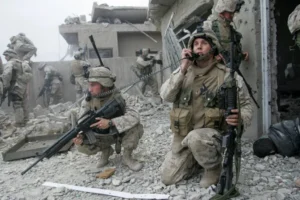
Iraq. Fallujah. November 2004. US company of Marines nicknamed “Charley” at work during operation “Phantom Fury” in the north east of Fallujah.
Second Battle of Fallujah Human Cost
Casualties were heavy on both sides. More than 95 U.S. service members were killed, and over 560 were wounded. The insurgents suffered devastating losses: estimates suggest over 1,200 killed.
Civilians were also affected, although most had fled prior to the battle. The destruction in Fallujah was vast, and the city required years of reconstruction.
How Fallujah Was Taken Block by Block
Strategically, Fallujah was divided into sectors, each cleared and secured block by block. Maps of the operation show a coordinated sweep from the northwest to the southeast, aiming to trap and neutralize insurgents while minimizing friendly fire.
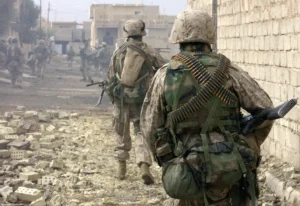
Members of 1st Battalion, 3rd Marine Regiment, Bravo Company, move back to the front line after 48 hours of rest at their base on November 20, 2004 in Fallujah, Iraq. (Marco Di Lauro/Getty Images).
Who Won the Second Battle of Fallujah— and Why Its Legacy Still Matters
Tactically, it was a decisive victory for U.S. and Iraqi forces. Insurgent control was broken, their leadership scattered, and the city was placed under Iraqi authority. But the cost was high, and the battle left scars on all who were there.
Yet beyond the tactics and territory, the true victory was in the character displayed by those who fought. It was won by the Marines who ran into buildings under fire. By the medics who treated wounds in stairwells. By the soldiers who carried their brothers through rubble-strewn streets.
The Second Battle of Fallujah became a proving ground for urban warfare doctrine, a study in leadership under pressure, and a story of sacrifice that continues to define the U.S. military ethos in the 21st century.
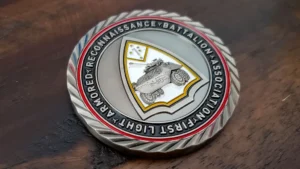
At Embleholics, we believe in more than memory—we believe in commemoration. The Second Battle of Fallujah is etched into the hearts of thousands who served, and it deserves to be etched in metal too.
Our custom challenge coins have honored battalions, celebrated reunions, and preserved moments of valor. For many veterans, a coin designed for their Fallujah deployment is more than memorabilia—it’s a tangible piece of history, earned in fire.
When we craft a coin, we don’t just engrave dates and emblems. We capture the grit, the brotherhood, and the legacy that battles like Fallujah represent.
Remember, for us, every coin tells a story. And Fallujah is a story that must never be forgotten.
Don’t forget to honor those who fight for us.
Recent Posts